48% Want AI. 13% Make Money From It. The Ladder Explains Why.
The five rungs of AI maturity. And why most businesses are stuck on the trap rung without knowing it.
The Gap Nobody Is Naming
The numbers are stark.
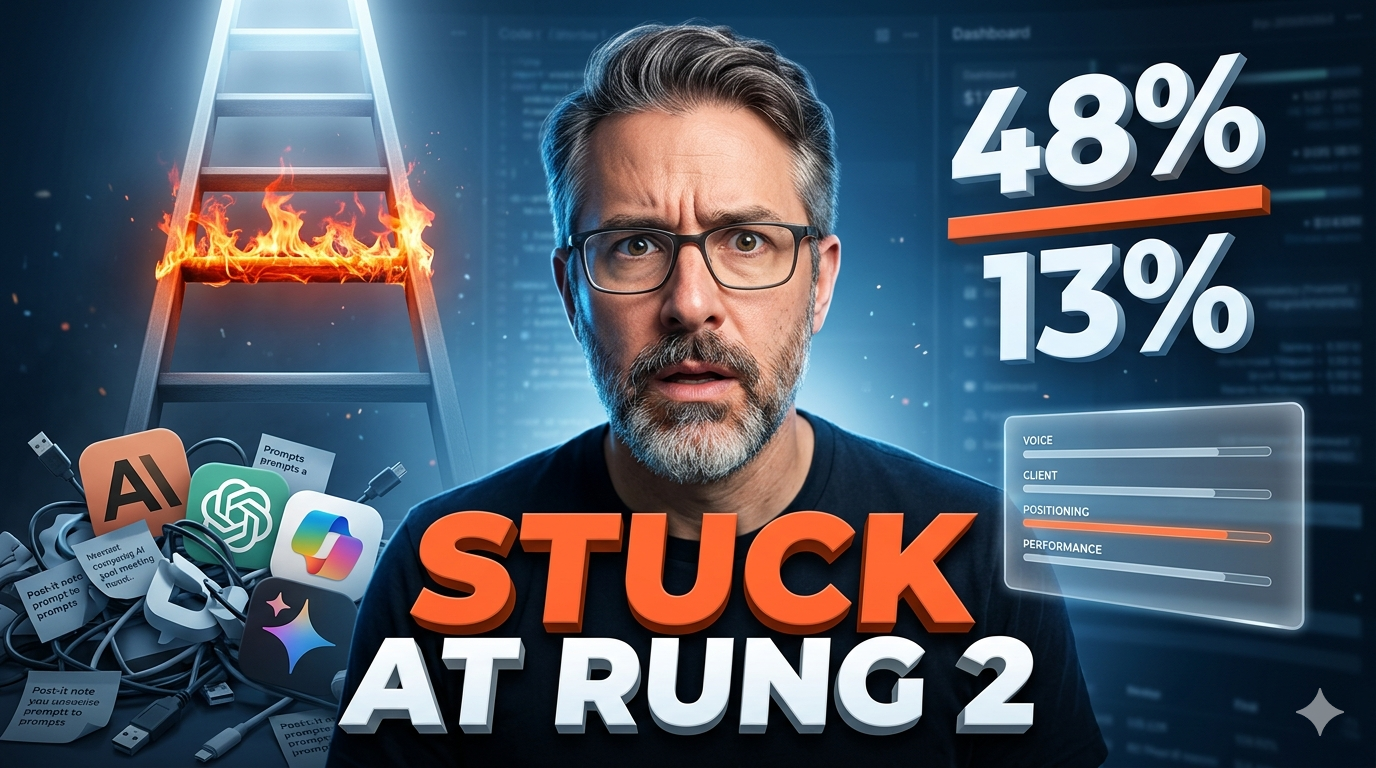
Forty-eight percent of MSPs identify AI as the number one thing their clients want. Thirteen percent are generating meaningful revenue from it. That is not a tools problem. That is a maturity problem. And it runs deeper than most owners realize.
Here is what I see happening across the market right now. Every business is buying licenses. Claude, ChatGPT, Copilot, Gemini. Somebody on the team is using one. Somebody else is using another. Nobody can tell you what they are actually using it for beyond "we want to use AI."
That sentence has no problem in it. No outcome. No direction.
I had a conversation with an MSP owner last week. Two of his clients had signed up for Claude Cowork without telling him. They are running into the platform blind. He is responding after the fact because everything is moving so fast. That is the entire industry right now. Shadow adoption. No policy. No strategy. Just licenses and hope.
Most owners think AI maturity is a license question. It is not.
AI maturity is a sequencing question. The same way marketing failure is a sequencing problem, not a tactics problem. You do not climb the ladder by buying more tools. You climb it by building the system that makes the tools work together.
By the end of this piece, you will know your actual rung. Most of you are not where you think you are.
The Five Rungs of AI Maturity
Rung 1: AI Curious
You have read the headlines. You watched a YouTube video. You opened ChatGPT once and asked it to write an email. You do not have a license. You do not have a system. You are watching from the sidelines.
There is no shame in being on rung 1. Most of the people on rung 5 today were on rung 1 a year ago. The problem is staying on rung 1 in 2026 while your competitors climb past you.
The only thing rung 1 costs is time.
Rung 2: AI Chaotic (The Trap)
You have licenses. Multiple. Probably more than you can name. There is a Claude account. There is a ChatGPT subscription. Somebody on the team is using Copilot for Word docs. Somebody else built a Custom GPT for proposals six months ago that you have not looked at since.
You have prompts. Most of them are in three different conversations across three different tools. Nobody can find them. Including you.
Output drifts. The voice on the proposal does not sound like the voice on the email. The email does not sound like the LinkedIn post. None of it sounds like you.
Here is the telltale sign you are on rung 2. If somebody on your team asks "where do I find that prompt you wrote" and the answer is "I think it is in one of my chats," you are on rung 2.
This is where most businesses are right now. And rung 2 feels like progress. There is activity. There are tools running. People are typing into things. It is not nothing.
But rung 2 is structurally broken. You do not have a foundation. Every new conversation starts from zero. Every new system gets built on top of nothing. And the chaos compounds.
The reason rung 2 is the hardest rung to escape is that it does not feel like a problem. It feels like the problem is just that you need a better prompt. Or a better tool. Or one more license.
It is not a prompt problem. It is a foundation problem.
Rung 3: AI Considered
You have stopped collecting tools and started thinking.
You picked one workflow. Maybe two. You built a prompt that actually works. You can run it on demand and it gives you something useful most of the time.
You have started to see what good looks like. You know there is a difference between a generic ChatGPT answer and a Claude answer that knows your business.
But you are still mostly manual. The team is not using it consistently. You are the one running it. If you stopped logging in tomorrow, the AI work would stop.
Rung 3 is real progress. But it is load-bearing on you. Which means it is not actually load-bearing.
Rung 4: AI Systematic
Your business runs on AI without you in the room.
You have a foundation. Four files. Voice. Client profile. Positioning. Performance memory. Loaded into every conversation, every project, every tool. The output sounds like you because the foundation is you.
You have systems. Five of them, give or take. Lead generation. Client communication. Onboarding. Internal knowledge base. Weekly reporting. Each one runs on the foundation. Each one is in the actual business making actual things happen.
Your team uses it without asking you. They open a project. The voice is already loaded. They do not write a system prompt because they do not have to.
Rung 4 is the rung where AI starts paying for itself.
Rung 5: AI Dominant
Your AI does things your competitor's AI cannot do. Not because you are smarter. Because your foundation files have data nobody else has. Every client engagement makes the system smarter. Every win, every objection, every win-back goes into performance memory.
Three years in, no competitor can replicate it.
This is the rung where AI stops being a tool and starts being a structural advantage. The gap between rung 5 and rung 2 will be the biggest competitive divide in service businesses since cloud.
Why Rung 2 Is the Trap
Most businesses are on rung 2 because they followed the conventional advice. Buy a license. Try the tool. Get your team trained. Read the article. Watch the bootcamp.
What they did not do is build a foundation. Because nobody told them they needed one.
I went to one of the major MSP AI events earlier this year. The instructors did not account for hallucinations. Nobody mentioned a foundation file. The whole event was sponsor talking points dressed as education. People left more confused than when they walked in.
The default path through 2026 leads straight to rung 2 and stops there.
Here is why rung 2 is so hard to escape. It does not feel like a problem. You have tools. You have output. You have activity. The chaos feels like the cost of progress, not a design flaw.
So you add another tool. You write another prompt. You hire someone to manage the prompts. You attend another webinar about the right AI tool to buy. And you stay on rung 2. Because none of those things build a foundation.
The only way out is to stop adding tools and start building the foundation underneath them.
Naming where you are is the first move out.
What the Foundation Actually Is
A foundation is not complicated. It is four files.
Your voice. How you actually talk. The patterns in how you think. The way you frame problems. This is not a brand guide. It is you, extracted and usable.
Your client profile. Who you actually serve. What problems they have. What they have already tried. What language they use when they describe the problem. This is not a target market. It is your actual customer.
Your positioning. The one thing you own in the market. The thing you say that nobody else says the same way. The claim your competitors cannot make. This is not a tagline. It is the edge.
Your performance memory. The wins you have had. The objections you have overcome. The patterns in how deals close. The things your team has learned. This is not a case study. It is your competitive edge, compressed into prompts.
Load those four files into every conversation. Load them into Claude. Load them into your internal tools. Load them into everything the team touches.
Now your output does not drift. Every conversation starts from the same foundation. Every system that runs on top of it speaks in the same voice. Your team does not ask where the prompt is. They open the project and the foundation is already there.
That is the difference between rung 2 and rung 4.
The Three-Week Climb
Most businesses think climbing from rung 2 to rung 4 takes months. It does not. It takes clarity. And three weeks of structure.
Week 1. You build the foundation. You extract your voice. You name your client. You claim your position. You pull your performance memory. Four files. Done.
Week 2. You build five systems on top of that foundation. Lead generation. Client communication. Onboarding. Knowledge base. Reporting. Each one is a workflow. Each one loads the foundation. Each one works in your actual business.
Week 3. You deploy. Your team starts using the systems. The voice is consistent. The systems work. And for the first time, the AI is not random output you have to curate. It is an extension of your business.
By the end of week 3, you have left rung 2 behind. You are on rung 4. The system is running without you in the room.
The Move
Here is what to do right now.
Name your rung out loud. Say it to yourself. Then ask whether your team would name the same rung if you asked them. Most teams give a different answer than the owner does. The gap between those two answers is your real starting point.
If you want a more structured way to map it, the AI Readiness Assessment is at orangenomad.com/ai-assessment. Eighteen questions. Five minutes. Tells you which rung you are on by behavior, not by feeling.
If you are on rung 2 and you want to climb, the AI Rollout Cohort is where that happens. Four weeks. Eight live sessions. You build the foundation in week 1. You build five systems across weeks 2 and 3. You deploy in week 4.
By the end, you have a Braintrust System plus five deployed systems running in your actual business. Not a workbook. Not a course. The actual thing.
The Cohort opens May 18. Enrollment for the waitlist opens May 4. Twenty seats.
Waitlist: orangenomad.com/ai-rollout
Andrew Moon built the AI Rollout framework after helping MSP owners escape the rung-2 trap across 47 discovery calls in Q1 2026. He has been in that seat. He figured out the sequence. Orange Nomad teaches the climb.

Andrew Moon is the founder of Orange Nomad and the creator of the 3Cs Framework — a repeatable marketing system built for MSP owners under $5M who are great at IT but struggling to find clients. Not a marketer who learned about MSPs. An MSP owner who learned marketing — the hard way.