AEO: AI Is Answering Your Clients' Questions. Without You.
Sarah ran an MSP in Atlanta. Twelve staff. Strong client retention. Good reputation in the market.
For three years she ranked number one for her primary keyword. Every month the traffic came. Every month the calls followed. She didn't build a lot of other channels because she didn't need to. The pipeline was predictable.
Then her traffic dropped 60% in 90 days.
Her rankings hadn't moved. She was still sitting at number one. Her SEO agency had no explanation. And for weeks, neither did she.
What hit her wasn't a Google penalty. It wasn't a competitor outranking her. It was something most MSP owners still haven't heard of.
It was an AI Overview.
What Actually Changed
In May 2024, Google launched AI Overviews to all US users. By late 2025, they were appearing in 60% of US searches.
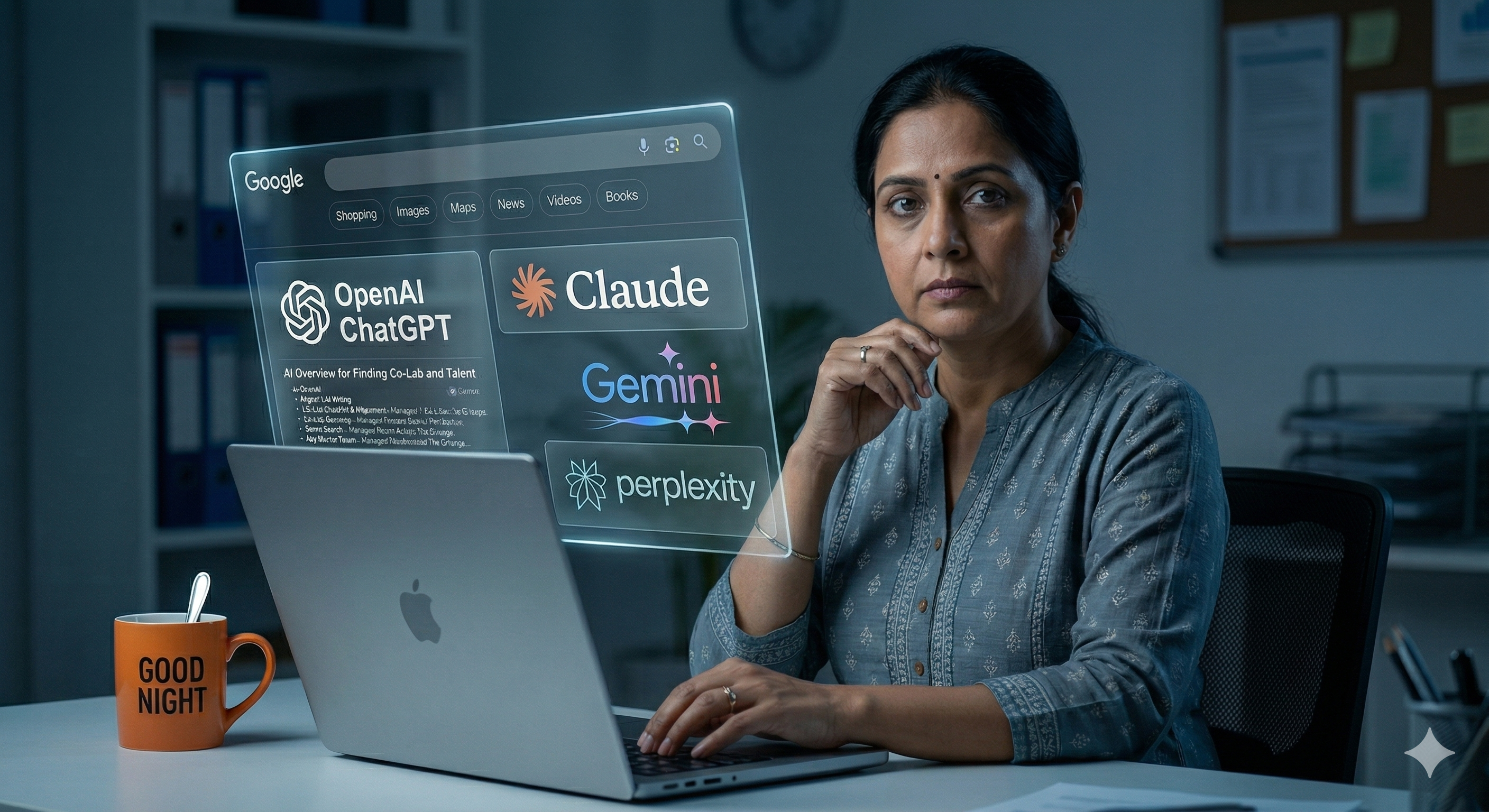
If you haven't noticed one yet, here's what they are. You type a query into Google. Before any blue links appear, a block of AI-generated text answers your question at the top of the page. The AI synthesises information from multiple sources, delivers the answer, and cites a handful of websites.
The user reads the answer. In many cases, they don't click anything.
Google has a name for this: zero-click search. For informational queries — the kind where a business owner is researching managed IT services, cybersecurity support, or compliance requirements before deciding who to call — the click rate has dropped sharply.
For MSPs, those are the exact queries that used to generate warm inbound leads.
Sarah wasn't penalised. She wasn't outranked. The game changed around her while she was still playing by the old rules.
This is not an isolated story.
The Diagnosis
The problem isn't that search is dying. Search is bigger than ever.
The problem is that the way search sends traffic to websites is changing fast, and most of the MSP market hasn't adjusted.
For 20 years, the model was simple. Rank high, get clicks. SEO was the discipline built around that model. You optimised your pages, earned your rankings, and got your visits.
That model still works for transactional queries — someone ready to buy, ready to call, ready to book. But for informational queries — the research phase, the comparison phase, the "what do I actually need" phase — AI is now answering the question before the click ever happens.
Three things define whether you have this problem:
Your traffic is down but your rankings are stable. That's the AI Overview fingerprint. You didn't lose the SEO race. You got bypassed.
Your primary service pages are generic. "We provide enterprise-grade IT support for businesses of all sizes." If that sentence could have been written by any MSP in any city, the AI has no reason to cite you over someone more specific.
You have no content that directly answers your clients' questions. Not blog posts about your company. Not case studies about your wins. Actual answers to the questions your clients type into search before they've decided who to call.
The Reframe
Here is the contrarian take worth sitting with.
The MSPs who are most exposed to AI Overviews are the ones who did SEO correctly by the old playbook. High domain authority. Consistent backlinks. Well-optimised service pages. They built for rankings, got rankings, and now those rankings are worth less because the AI is reading the page and summarising it instead of sending traffic.
The MSPs who will win AEO are not necessarily the ones with the biggest websites. They are the ones who write like they actually understand their clients' problems. Specificity, not scale. Structure, not volume.
This is genuinely good news for smaller MSPs who never had the budget to compete on domain authority. AEO rewards a well-written, well-structured page targeting a real niche over a sprawling generalist site optimised for every keyword.
The window is open right now. Most of your competitors are still confused about what AEO even means.
The Framework: Four Signals That Get You Cited
AEO — AI Engine Optimization — means optimising for how AI systems select and cite sources when generating answers. It is different from SEO in a specific way: where SEO rewards authority signals at the domain level, AEO rewards relevance and clarity at the passage level.
The AI scans your page, finds the paragraph that best answers the query, and either cites you or doesn't. Here are the four signals that tip that decision in your favour.
Signal one: Specificity. AI systems favour content written for a defined audience. "We help dental practices in Chicago protect patient data and stay HIPAA-compliant" will outperform "we serve businesses of all sizes" in AI citation every time. Not because it sounds better — because it answers a more specific query more completely. The more precisely you name who you help and what problem you solve, the more surfaces your content becomes citable for.
Signal two: Question-and-answer structure. AI Overviews are built to answer questions. If your content directly and clearly answers the questions your clients are actually typing into Google, you are giving the AI the exact format it needs. Write FAQ sections. Structure your service pages with H2 headings that are real questions your clients ask. Do not bury your answers in paragraphs of company background. Put the answer first.
Signal three: Named, attributable expertise. The AI is more likely to cite a source it can attribute to a real expert. This means having a clearly named author on your pages. It means being mentioned consistently in industry directories, publications, and third-party sources. Your E-E-A-T score — experience, expertise, authoritativeness, trustworthiness — matters more in an AEO world than it did in a pure SEO world. You are not just building a website. You are building a citable identity.
Signal four: Structured data. Schema markup tells search engines and AI systems what your content is about. FAQ schema, LocalBusiness schema, Service schema. If your developer hasn't added these, they go on the list. Structured data does not guarantee citation, but it removes a layer of friction between your content and the AI's ability to parse it.
The Analogy
Think of it this way.
The old SEO model was a library catalogue. You wanted your book on the shelf closest to the front door. The more times it was checked out, the higher up the shelf it climbed. Prominence was built on volume and authority.
AEO is closer to being the expert a journalist calls.
The journalist doesn't call you because your website is big. They call you because you are the clearest, most specific, most credible voice on the exact topic they're covering today. You built that reputation by saying something specific and useful in public, repeatedly, with your name on it.
That is what AI citation rewards. Not the biggest site. The most citable source.
What Happened to Sarah
Sarah rewrote her primary service page. She restructured it around five questions her best clients had asked before signing. She added FAQ schema. She published one article per month on a specific compliance challenge facing her target vertical.
Within six weeks, her content started appearing as a cited source in AI Overviews for her target queries.
Her traffic didn't fully recover to where it was. But her inbound quality improved. The calls coming in had already read a real answer and decided she was credible before dialling.
That is what AEO looks like when it works. Not a return to the old model. A better version of it.
The Move
One action this week. Takes four minutes.
Open Google. Search your primary service keyword — the one that used to drive traffic.
Look at the top of the page. Does an AI Overview appear? Read it. Does it cite you? Does it cite a competitor? Does it cite nobody local?
Write down what you see. That is your AEO baseline.
You cannot build a strategy from a problem you have not measured.
The 3Cs 90-Day MSP Marketing Action Plan covers AEO positioning as part of the first month of work. If you want a clear picture of where you stand and exactly what to fix, the link is in the comments.

Andrew Moon is the founder of Orange Nomad and the creator of the 3Cs Framework — a repeatable marketing system built for MSP owners under $5M who are great at IT but struggling to find clients. Not a marketer who learned about MSPs. An MSP owner who learned marketing — the hard way.