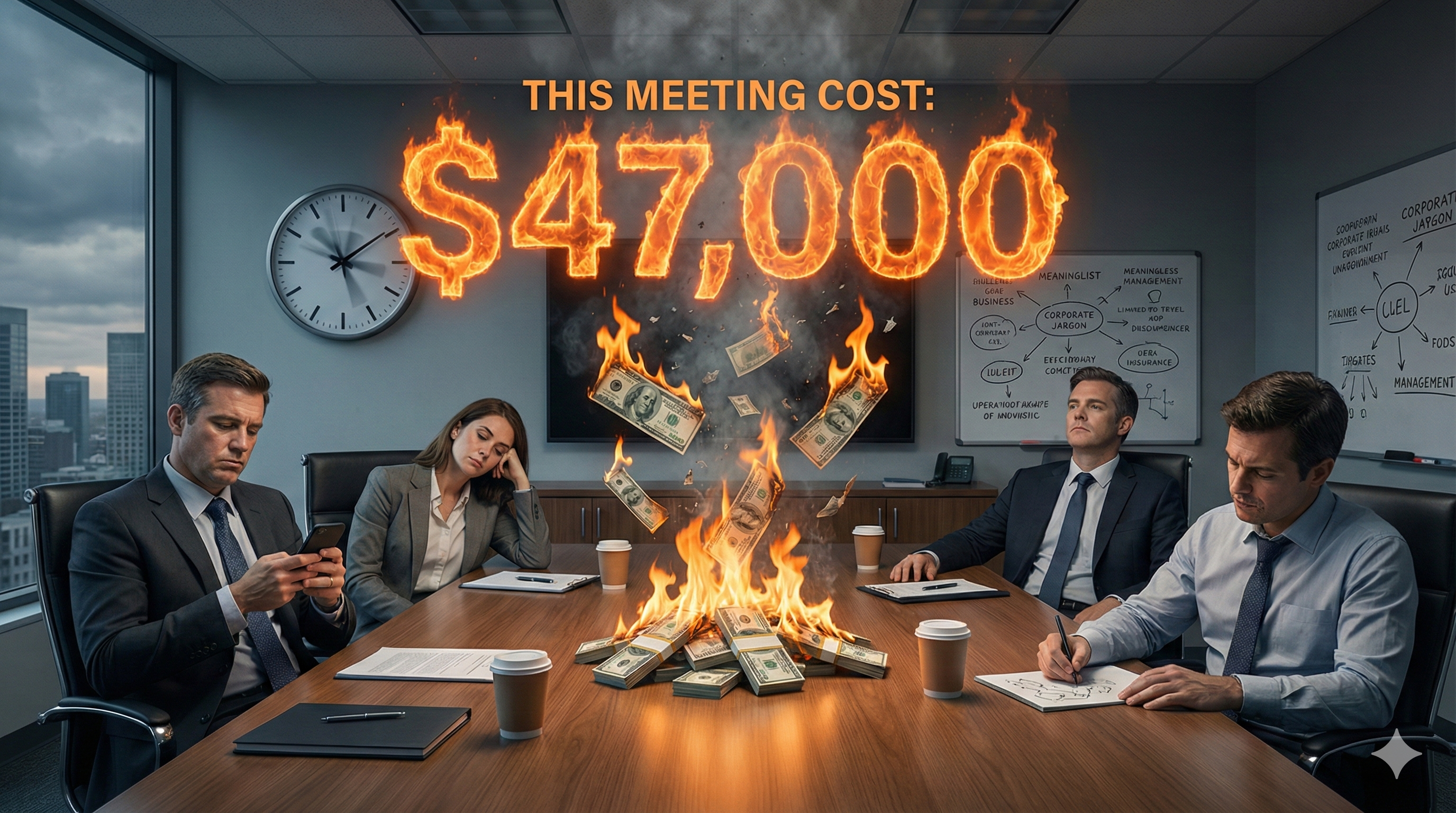
The $47,000 Meeting That Shouldn't Exist
Let’s do some quick math.How many hours per week does your team spend in meetings? Be honest.
Now multiply that by the average loaded cost per hour of the people in those meetings. Now multiply by 52 weeks. Got your number?
Now here’s the gut punch: At least HALF of those meetings didn’t need to exist. That status update? Could’ve been a Loom.
That brainstorm? Three people talked, eight watched. That weekly sync?
Covers the same ground as last week’s sync. You’re not running a company.You’re running a very expensive meeting factory.
THE PROBLEM
Here’s the thing about meetings: They FEEL like progress. You gathered people.
Discussed important things. Made decisions (sometimes). Left feeling productive.
But here’s what actually happened: You discussed problems instead of solving them. You talked about work instead of doing work. You created the ILLUSION of progress.
Let’s do the real math:A one-hour meeting with 8 people isn’t one hour. It’s EIGHT hours of collective human time. Now add the context-switching cost—the time it takes everyone to get back into deep work mode after the meeting ends.
That one-hour meeting actually consumed closer to 12 productive hours. Now multiply that by every meeting on your calendar. Studies show that 40-60% of meetings fail a basic test: “Could this have been an email?” That’s not a meetings problem.That’s a culture problem.
Somewhere along the way, “meeting” became the default response to every question, every decision, every piece of information that needs to move.
THE SHIFT
Here’s how to fix it: The 2-Week Meeting Audit — For two weeks, track every meeting with four questions:1. What was the stated purpose?2. Was there an agenda?3.
What decisions were made?4. What action items came out? I guarantee you’ll find meetings with no purpose, no agenda, no decisions, and no actions.
Those meetings shouldn’t exist. The Three Questions Gate — Before any meeting gets scheduled, answer three questions: 1. What decision needs to be made? (If no decision, it’s not a meeting—it’s an email)2. Who is essential to make this decision? (Everyone else is optional or shouldn’t be there)3.
What’s the minimum time needed? (Not an hour because that’s the default—the actual minimum) Flip Your Default — Right now, your default is “meet” and async is the exception. Flip it. Default to Loom.
Default to Slack. Default to a shared doc. Save meetings for things that ONLY work in real-time: sensitive conversations, creative brainstorms that need energy, complex negotiations. The 30-Minute Maximum — No meeting should be longer than 30 minutes without explicit justification.
Not because 30 minutes is magic, but because it forces preparation. When you only have 30 minutes, you can’t waste 15 minutes “getting everyone up to speed.” You have to send pre-work. You have to have an agenda.
You have to be ruthless. Meeting-Free Days — Block one full day per week where NO meetings are allowed. Guard it ruthlessly. This isn’t a perk.
It’s a productivity investment. Deep work requires uninterrupted time. Meetings fragment that time into unusable pieces.
THE CLOSE
Here’s your transformation: BUSY → PRODUCTIVE.
Meetings should be expensive interventions, not free-flowing defaults. Every meeting should earn its right to exist. Your action step: For the next two weeks, track every meeting with those four questions.
At the end, calculate how many hours were spent in meetings that produced no decisions and no actions. That number will change how you think about your calendar.Share this with someone drowning in meetings. Subscribe, because next week we’re telling the story of a founder who “quit”—and doubled her revenue.
Until then—go bury some chaos.

Andrew Moon is the founder of Orange Nomad and the creator of the 3Cs Framework — a repeatable marketing system built for MSP owners under $5M who are great at IT but struggling to find clients. Not a marketer who learned about MSPs. An MSP owner who learned marketing — the hard way.