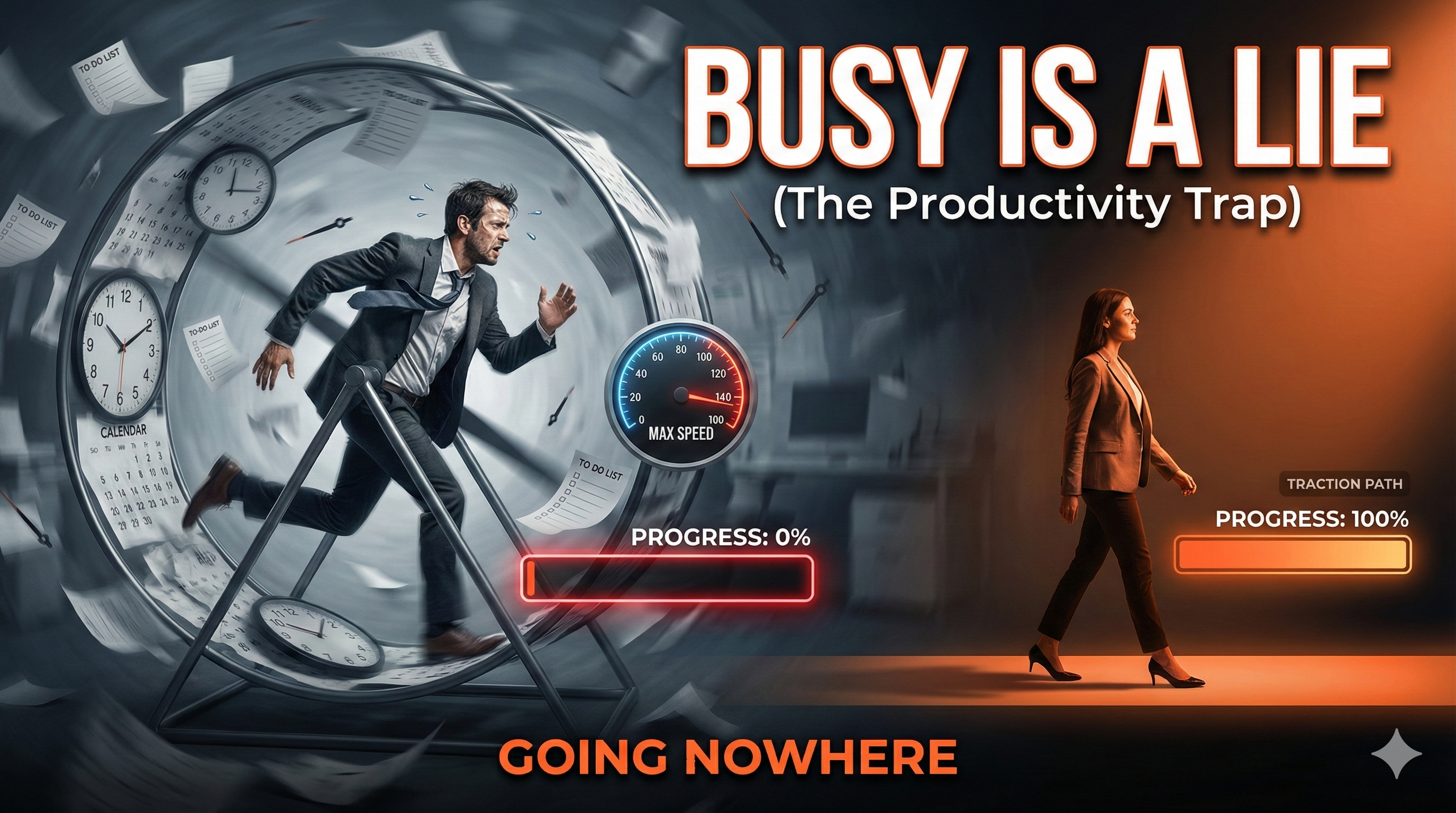
Busy Is a Lie You Tell Yourself
What did you actually ACCOMPLISH last week? Not what did you DO.
Not how many hours you worked. Not how many emails you answered or meetings you attended. What did you actually ACCOMPLISH?
Because here’s the thing: Founders are world-class at being busy. We can fill every hour with tasks, meetings, emails, calls. We collapse into bed exhausted, convinced we gave it everything.
But when someone asks what we actually MOVED forward?Suddenly it gets quiet. Being busy has become a status symbol. A badge of honor.
A way to feel important without actually BEING important. Today, we bury that lie.
THE PROBLEM
Let’s be honest about what “busy” actually means: “Busy” means you’ve lost control of your time.“Busy” means you say yes to everything.“Busy” means you confuse motion with progress.“Busy” means you’re afraid that slowing down means falling behind. Here’s the brutal truth: Most founders’ 80% of activity creates only 20% of results.
The rest is expensive motion disguised as progress. You spend hours: Responding to emails that don’t need responses. Attending meetings that don’t need attendance.
Making decisions that don’t need you. Perfecting things that don’t need perfection. Helping people who don’t need help.
And you feel good about it. Because you’re BUSY. But busy isn’t productive.
And productive isn’t effective. Here’s the mantra: Effective beats productive. Productive beats busy.
Busy is just noise. Most founders are stuck at busy. Some graduate to productive.
Very few operate at effective.
THE SHIFT
Here are the four filters that separate busy from effective:
Filter 1: The Outcome Test
— Before any task, ask: “What outcome does this create?” Not “what will this accomplish” (vague) but “what specific OUTCOME?” If you can’t name a clear outcome, question the task. If the outcome doesn’t matter, delete the task.
Filter 2: The $1,000/Hour Test
— Imagine you have to pay $1,000 for every hour you spend working. Cash.
Out of pocket. Would you pay $1,000 to respond to that email? Would you pay $1,000 to sit in that meeting?
Would you pay $1,000 to do that task yourself instead of delegating? This filter reveals how much “busy work” you’re doing that isn’t worth your time.
Filter 3: The Energy Audit
— You have 3-4 hours of peak cognitive energy each day. Maybe morning.
Maybe afternoon. Whenever your brain is sharpest. What are you spending those hours on?
Most founders waste peak energy on email, meetings, and reactive work—then try to do strategic thinking when they’re exhausted. Flip it. Protect peak hours for highest-leverage work.
Push busy work to low-energy times.
Filter 4: The “Stop Doing” List
— You have a to-do list. You need a STOP DOING list. Every week, identify one thing you’re going to completely stop doing.
Not delegate. Not do less of. STOP.
Maybe it’s a meeting that doesn’t need to exist. Maybe it’s a report nobody reads. Maybe it’s a process that doesn’t serve anyone.
Kill it. See if anyone notices. (They usually don’t.)
THE CLOSE
Here’s your transformation: SPINNING WHEELS → TRACTION. Effective beats productive.
Productive beats busy. Busy is just noise. Your action step: Tomorrow, apply the $1,000/Hour Test to everything on your calendar.
Would you pay $1,000 to do it? If not, delete it or delegate it. Share this with a founder who wears “busy” like a badge.
Subscribe, because next week we’re solving the mystery of why your team asks you the same question 47 times. Until then—go bury some chaos.

Andrew Moon is the founder of Orange Nomad and the creator of the 3Cs Framework — a repeatable marketing system built for MSP owners under $5M who are great at IT but struggling to find clients. Not a marketer who learned about MSPs. An MSP owner who learned marketing — the hard way.