Why Your Team Asks You the Same Question 47 Times
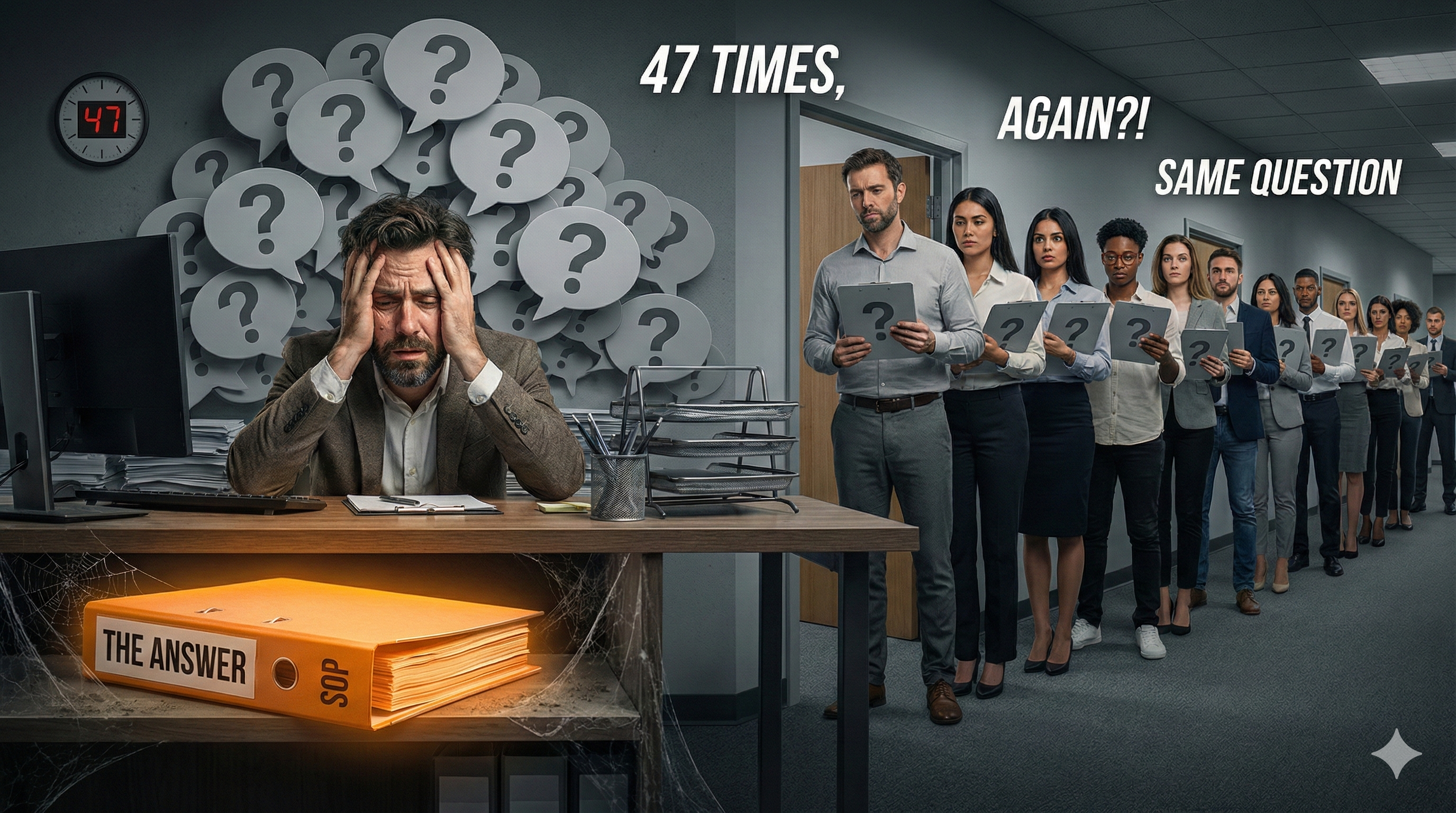
How many times have you answered the same question this month?
"What's the process for onboarding?" "Where do we store the contracts?" "What's our refund policy?" "How do I handle this type of client request?"
Every time, you stop what you're doing. You explain—again. Your brain thinks, "I've told them this three times."
And you start to wonder: Is my team just... not paying attention?
Here's the diagnosis: Your team isn't broken. Your documentation is.
Every repeated question isn't a forgetful employee. It's a missing document.
THE PROBLEM
Let's do the math on this:
15 interruptions per day asking you questions. 5 minutes each—between the question, your explanation, and getting back on task. That's 75 minutes daily. 6+ hours weekly. 300+ hours per year.
That's nearly TWO MONTHS of full-time work—just answering questions that could have been documented.
But here's the deeper problem: Every time you answer a question verbally, you train your team to ASK instead of FIND.
They learn: "Need to know something? Ask the founder. They'll explain it."
So they do. Again and again.
You become a human FAQ. A walking Wikipedia. The institutional memory that everyone queries instead of documenting.
And here's the worst part: Your answers aren't even consistent. Monday you say one thing. Thursday you say another. The "process" is whatever you happen to remember in the moment.
No wonder your team is confused.
THE SHIFT
Here's the system that makes repeat questions disappear:
Step 1: The Question Log — For two weeks, track every question you get. Who asked it, what they asked, how long it took you, and whether it was a repeat. Don't try to fix anything yet. Just track. At the end of two weeks, you'll have a clear list of your biggest documentation gaps—ranked by frequency and time cost.
Step 2: The SOP Sprint — Take your top 10 repeated questions. Create simple, one-page documentation for each one. One per day. Ten days. Done. You don't need fancy SOPs. A bullet-point checklist works. A Loom video works. Something that answers the question WITHOUT requiring you. The bar isn't perfection. The bar is "better than asking the founder."
Step 3: The "Check the Doc" Response — Here's where most founders fail: They create documentation but keep answering questions anyway. When someone asks you a question that's documented, your answer is NOT the answer. Your answer is: "Great question—check the SOP. Let me know if anything's unclear after you read it." Every. Single. Time. Yes, this feels slower at first. Yes, they'll still ask you. But after a few weeks of "check the doc," they'll start checking the doc FIRST.
Step 4: The Loom Library — Some things are easier to show than write. Build a library of video answers. When someone asks a process question, record yourself answering it—then save that video. Next time? Send the link.
Step 5: The Update Trigger — Documentation goes stale. Processes change. Create a simple rule: Anyone who finds an outdated doc MUST update it. Not flag it. Not mention it. UPDATE it. This keeps your documentation alive without requiring you to maintain it.
THE CLOSE
Here's your transformation: INCONSISTENT → PREDICTABLE.
Document once, answer forever. That's the goal.
Your action step: Start a Question Log today. For two weeks, track every question you get asked. At the end, you'll have a perfect roadmap for what needs documentation.
Share this with a founder who's tired of being a human FAQ. Subscribe, because next week we're diagnosing a serious condition: Your business has Alzheimer's.
Until then—go bury some chaos.

Andrew Moon is the founder of Orange Nomad and the creator of the 3Cs Framework — a repeatable marketing system built for MSP owners under $5M who are great at IT but struggling to find clients. Not a marketer who learned about MSPs. An MSP owner who learned marketing — the hard way.