Vibe Coding Is Killing WordPress (And Honestly, Good Riddance)
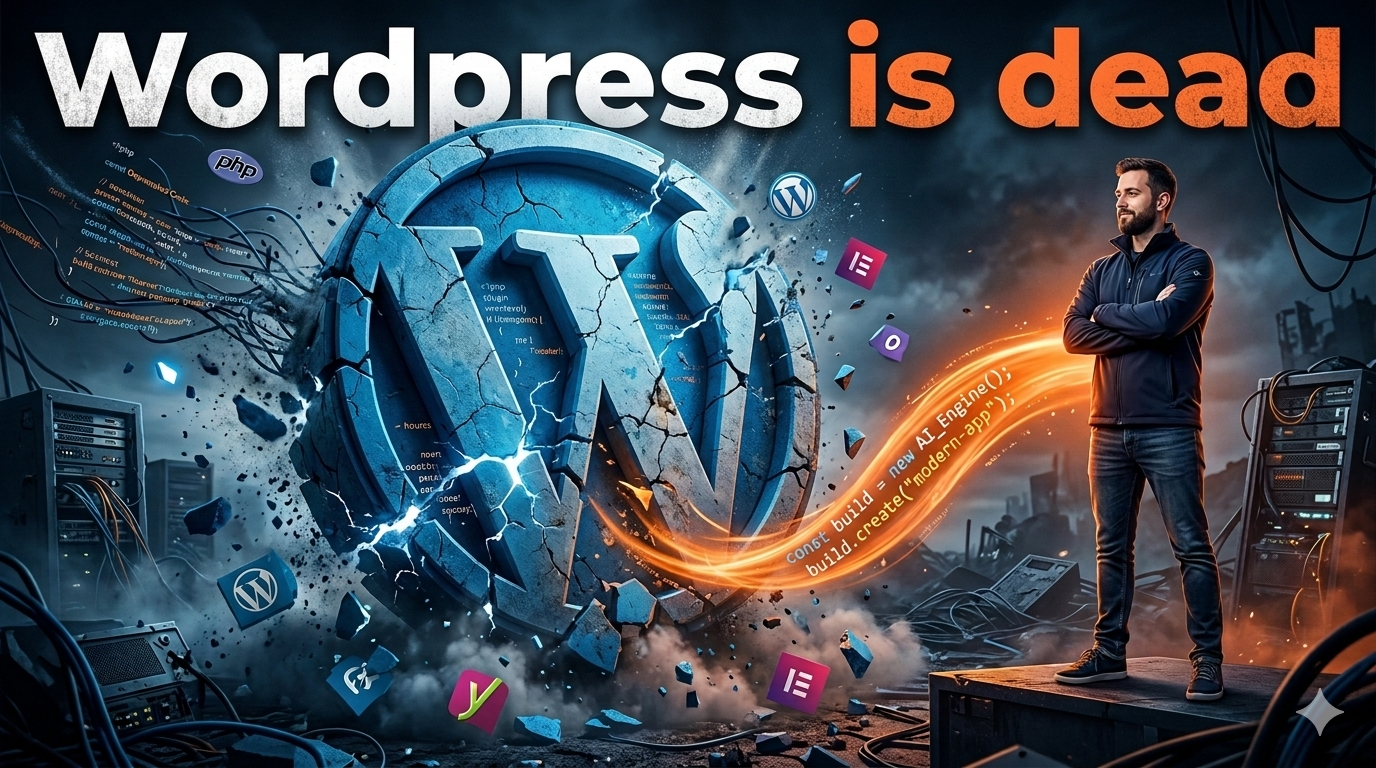
WordPress had a great run.
Twenty years. Forty percent of the internet. Millions of businesses built on a foundation of blue "W" logos, plugin dashboards, and the constant low-grade anxiety of a site that could break at any moment.
And now? It's over.
Not slowly. Not quietly. Fast. The way a thing ends when something better shows up and founders finally realize they've been carrying dead weight for years.
That something better is called vibe coding.
And if you haven't heard of it yet, buckle up. This is the most important shift in how lean founders build and run their businesses since the cloud made servers optional.
First, Let's Be Honest About What WordPress Actually Is
Here's the deal. WordPress wasn't built for you.
It was built for bloggers in 2003. Then it grew. Plugins got added. Themes got bolted on. A whole economy of developers, page builders, and maintenance subscriptions grew up around it, all built on the fundamental premise that running a website is complicated and you need help.
That premise was true. For a long time.
But let's be real about what it cost you.
You paid a developer to set it up. Then you paid another developer to fix what the first one broke. You bought a theme. Then a premium theme. Then a page builder so you didn't have to use the developer every time you wanted to change a headline. You installed plugins for SEO, speed, security, forms, popups, email capture, and social sharing. Each one adding weight. Each one requiring updates. Each one a potential failure point.
You've refreshed your site after clicking "Update All" and held your breath.
You know exactly what I mean.
That's not a website. That's a liability with a home page.
And the wild part? You told yourself this was normal. That this is just what having a website costs. That complexity was the price of doing business online.
It wasn't. It isn't. And the founders who figure that out first are going to move faster than everyone still wrestling with WooCommerce settings at midnight.
What "Vibe Coding" Actually Means
Let me kill the hype before it kills the point.
Vibe coding sounds like something a 22-year-old in a hoodie invented to sound cool. The name is a little chaotic. The capability behind it is not.
Vibe coding is the practice of using AI tools, specifically large language models, to generate, build, and iterate on code through natural language conversation. You describe what you want. The AI builds it. You refine it. You ship it.
No Computer Science degree. No developer retainer. No ticket system. No waiting three weeks for a change that takes three minutes to describe.
The term was popularized by Andrej Karpathy, former Director of AI at Tesla and founding member of OpenAI, who described the shift simply: you're not really coding anymore. You're directing. You're describing. The AI handles the syntax. You handle the vision.
For founders, that changes everything.
Here's why.
The Old Model Required Translators. The New One Doesn't.
Think about every interaction you've ever had with a web developer.
You had an idea. You described it. They interpreted it. They built something. You said "not quite." They revised it. The bill went up. Time went by. You eventually settled for something close enough and moved on.
That translation layer, from founder idea to developer execution, was slow, expensive, and lossy. Things got lost in translation constantly. Your vision got diluted by their interpretation, their availability, their pricing, their technical preferences.
Vibe coding collapses that gap.
When you can describe a landing page in plain English and have a working draft in front of you in minutes, you've eliminated the translator. You're working directly with the raw material. You're iterating at the speed of thought instead of the speed of a development sprint.
That's not a minor upgrade. That's a category shift.
It's the difference between dictating a letter and writing one yourself. Between describing a design to an artist and being able to sketch it directly. The feedback loop gets so tight that the process of building something and the process of thinking about what you want become nearly the same thing.
Why WordPress Is the Wrong Tool for This Era
WordPress is a system built around the assumption that building websites requires specialists.
Every piece of its architecture reflects that assumption. The dashboard was designed for technical users. The plugin ecosystem assumes you need pre-built solutions because custom solutions are expensive. The theme marketplace exists because designing from scratch requires skills most founders don't have.
Remove that assumption. Remove the idea that building requires specialists. The entire WordPress value proposition collapses.
Why install a $299/year plugin for a form builder when you can describe exactly the form you want and have it built in ten minutes?
Why pay a developer $150/hour to adjust your layout when you can describe the change yourself and have a working version in front of you before the developer would have even replied to your email?
Why carry the weight of a WordPress install (the database, the hosting requirements, the security vulnerabilities, the update dependencies) when you can build something lighter, faster, and more custom for less?
You can't. There's no good reason.
WordPress solved a real problem. That problem no longer exists in the same form.
The Plugin Graveyard Is Real
Every WordPress site I've ever looked at has it.
The plugin graveyard. A list of installed plugins, half of them inactive, some of them last updated three years ago, several of them doing things that could be replaced by a single AI-generated function.
Here's what's in a typical founder's WordPress graveyard:
A contact form plugin that does exactly one thing and costs $79/year
An SEO plugin configured by someone who left the company eighteen months ago
A speed optimization plugin that exists to compensate for the other slow plugins
A security plugin that sends alarming emails every week and never explains what to do about them
Three different image plugins from three different attempts to fix the same problem
A social sharing plugin from 2019 that hasn't been touched since
Each one is a dependency. Each one has to be maintained. Each one can conflict with the others. Each one is a potential door left unlocked.
And here's the kicker: most of those plugins exist because building that feature from scratch used to require a developer. That's no longer true. You can describe what you want, build it yourself in minutes, own it completely, and skip the annual subscription forever.
The plugin economy was built on your inability to build things yourself.
That inability is expiring.
What the New Stack Actually Looks Like
Let's get practical. Because I'm not here to just criticize WordPress. I'm here to show you what replaces it.
The new stack for lean founders is simpler, faster, and more founder-owned than anything WordPress ever offered.
For websites and landing pages: Tools like Framer, Webflow, and Cursor let you describe pages and see them built in real time. No themes. No plugins. No database to manage. Pages load faster, look better, and cost less to maintain.
For custom functionality: Claude, ChatGPT, and GitHub Copilot let you build forms, calculators, automations, and integrations by describing what you need. The code gets generated. You test it. You ship it. The whole cycle takes hours, not weeks.
For content: AI-assisted writing tools mean your blog posts, landing page copy, and email sequences stop requiring a content team to produce at scale.
For automation: Platforms like n8n and Make connect your tools and trigger workflows automatically, and AI can help you build those automations faster than any developer could.
The pattern across all of it is the same. You describe. AI builds. You own it.
No plugin subscriptions. No developer dependencies. No "update required" anxiety.
But Isn't This Just for Tech People?
Real talk: this is the objection I hear most from founders, and it's the one that's most wrong.
Tech people built the old tools for tech people. Vibe coding is specifically designed to bridge that gap. It lets non-technical people build technical things by removing the technical barrier to entry.
You don't need to know what a function is. You don't need to understand how a database works. You don't need to remember the difference between front-end and back-end.
You need to know what you want. You need to be able to describe it clearly. And you need to be willing to iterate. To say "that's close, but not quite, because..." and keep refining until it's right.
Those are founder skills. You already have them.
You describe your vision to employees, partners, and clients every day. You explain what success looks like. You say "that's not what I meant, here's what I actually need."
Vibe coding is just that conversation, with an AI that can actually build the thing while you're talking.
The Calm Business Angle Nobody's Talking About
Here's what I really want you to see. Because the WordPress vs. vibe coding conversation usually gets framed as a tech debate. Developers on one side, AI enthusiasts on the other, everyone arguing about code quality and edge cases.
That's the wrong frame.
The right frame is this: every hour you spend managing tools is an hour you're not leading your business.
The Building Calm: Bury The Chaos® framework exists because overwhelmed founders aren't overwhelmed because they don't work hard enough. They're overwhelmed because they carry too many systems, too many dependencies, too many moving parts they don't fully understand or control.
WordPress is a perfect example of exactly that problem.
It's a tool that started simple and accumulated complexity like a magnet accumulates metal shavings. Every plugin adds a decision. Every update adds a risk. Every developer dependency adds a delay. The weight compounds quietly until you're spending real time and real money managing a tool that's supposed to serve you. Instead, you're serving it.
Step 7 of the Building Calm framework is Leverage. The whole point of that step is to deploy tools and systems that multiply your output without multiplying your workload. A tool that requires its own maintenance team is the opposite of leverage. It's anchor weight.
Vibe coding is leverage. It lets you build faster, own more, and maintain less. That's not just a tech upgrade. That's a direct path to a calmer, more controlled business operation.
The Real Cost of Staying on WordPress
Let me give you a number to think about.
If you have a developer or agency managing your WordPress site, you're spending somewhere between $500 and $3,000 per month on maintenance, updates, and "the site went down at 2 AM" emergencies.
Add plugin licenses. Add premium theme renewals. Add the hours your internal team spends submitting tickets and waiting for changes that should take twenty minutes.
For a founder doing $500K a year, that's potentially 5-10% of revenue spent on keeping a website alive.
Now ask yourself: what would that same investment look like if you deployed it toward actually building things instead of maintaining things?
What if instead of paying someone to update plugins, you used that budget and that time to build better landing pages, faster customer experiences, and tighter automations that actually grow the business?
That's the real cost of staying on WordPress. Not just the dollars. The opportunity cost of all the building you didn't do because you were too busy maintaining.
"But What About SEO? WordPress Is Great for SEO."
Yes. WordPress has excellent SEO tools.
Yoast is genuinely good. The SEO infrastructure of WordPress is mature and well-documented.
Here's the thing: SEO lives in the content, the structure, and the speed of your site. Not in the platform.
A vibe-coded site with clean HTML, fast load times, proper heading structure, and strong content will outperform a slow, plugin-heavy WordPress site in search rankings. Every time.
The SEO advantages of WordPress are real but they're also replicable. And the SEO disadvantages of a bloated, slow, poorly-maintained WordPress site are also very real. Founders deal with them constantly.
Fast pages win. Clean structure wins. Strong content wins. None of those require WordPress.
"But My Developer Built Everything in WordPress."
I know.
And I'm not telling you to blow it up tomorrow. That's not the Building Calm way. We don't create chaos to escape chaos.
What I am telling you is to stop adding to it. Stop buying new plugins to solve new problems. Stop asking your developer to build new things in a platform you're going to migrate away from anyway.
Start learning the new tools. Spend one hour with Claude or Cursor and just describe something you've been meaning to build. A landing page. A simple intake form. A resource page you've had on your to-do list for six months.
See what happens when you describe it instead of outsource it.
My guess? You'll build it faster than your developer would have quoted it. And you'll understand it better because you built it yourself.
That's where the shift starts. Not with a dramatic migration. With one experiment that makes you realize the old assumption, "I need a specialist for this," was never as true as you thought.
The Founders Who Move First Will Win
Every major technology shift has the same arc.
First, the early adopters look crazy. Then they look smart. Then everyone else scrambles to catch up and pretends they were always on board.
We are at the "early adopters look smart" stage of vibe coding right now.
The founders who learn to work with AI tools directly, who stop waiting for developers and start building themselves, are going to have a compounding advantage over the next three to five years that will be genuinely difficult for slower-moving competitors to close.
They'll build faster. Iterate faster. Respond to market changes faster.
They'll spend less on maintenance and more on growth.
They'll own their tools instead of renting dependencies.
And they'll do it all while working fewer hours. They'll have eliminated an entire category of bottleneck from their business.
That's the Building Calm promise applied to technology. Not more tools. Better tools. Tools that serve you instead of tools you serve.
What To Do Right Now
If you want to start, here's your Day One action plan. Simple. No drama. No big migration.
1. Audit your WordPress costs. Add up your hosting, your plugins, your developer fees, and your team's time spent on website-related tasks. Get an honest number. That number is your leverage point.
2. Pick one small thing to vibe code. Not your whole site. One thing. A landing page. A form. A simple tool. Open Claude or Cursor, describe what you want, and build it. Give yourself two hours.
3. Notice the feeling. When you build something yourself that you would have previously outsourced, pay attention to how that feels. That feeling of ownership, speed, and clarity is what the new model runs on.
4. Make a decision about your timeline. You don't have to migrate today. But you should know when. Six months? Twelve? Have a date. Otherwise "eventually" turns into "never."
The Bottom Line
WordPress isn't evil. It served millions of founders well for a long time.
But the era of needing a specialist to build things on the web is ending. Fast. And the smart move is to see that clearly and act accordingly. Not out of panic. Out of calm, strategic awareness.
That's what calm business operators do. They don't chase trends. They recognize real shifts and move with intention.
This is a real shift.
Vibe coding is real. The capability is here now. The founders benefiting from it aren't waiting for permission or for the tools to get more polished.
They're building. Right now. Faster than you think.
The only question is whether you're going to be one of them.

Andrew Moon is the founder of Orange Nomad and the creator of the 3Cs Framework — a repeatable marketing system built for MSP owners under $5M who are great at IT but struggling to find clients. Not a marketer who learned about MSPs. An MSP owner who learned marketing — the hard way.