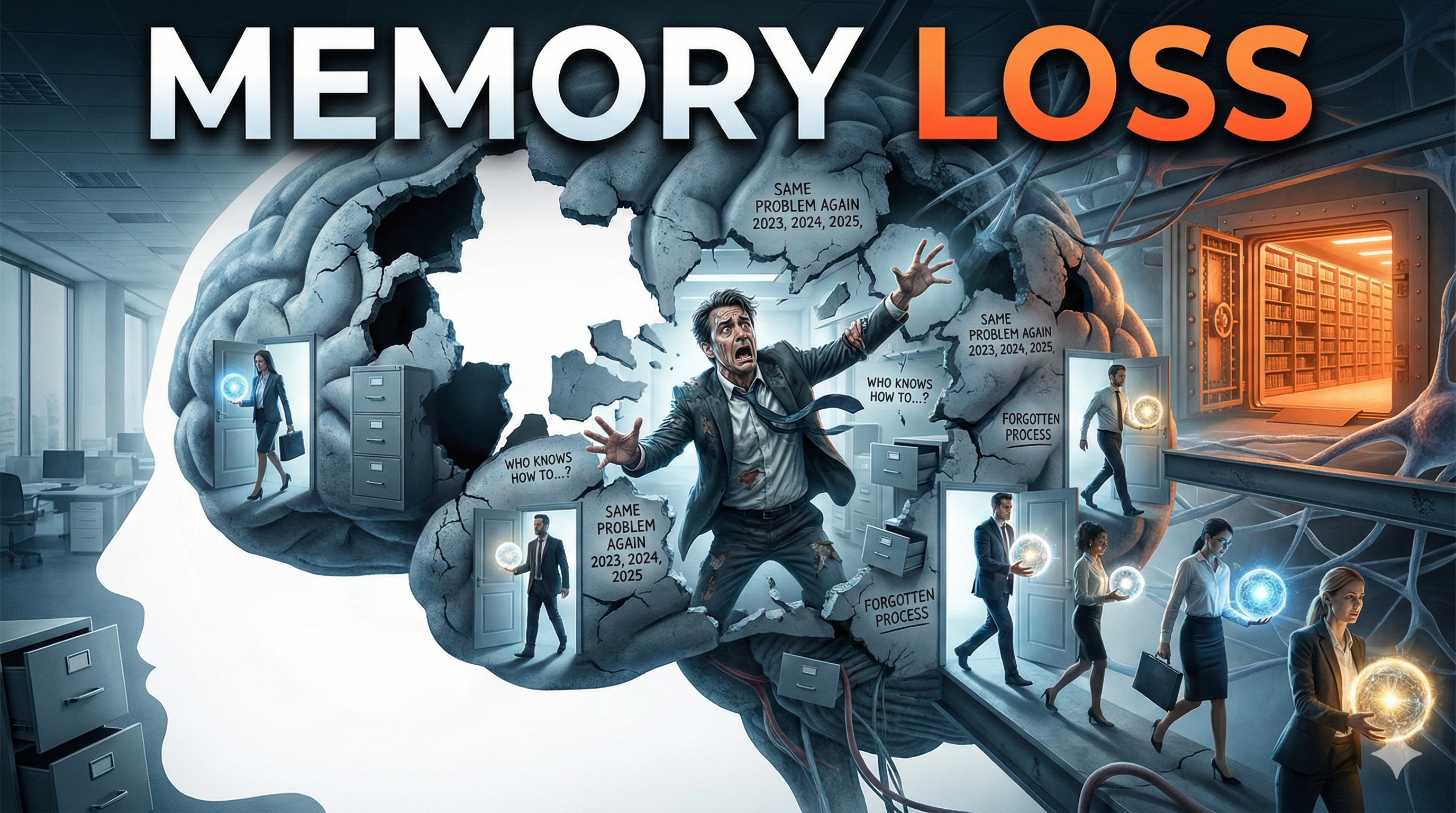
Your Business Has Alzheimer's (And You're the Only Memory It Has)
Your best employee gives two weeks notice.
Your stomach drops. Not because they're leaving—but because of everything they're taking WITH them.
How they handle that tricky client? Gone. Their system for hitting numbers? Gone. All those shortcuts they figured out? Gone. The context behind a hundred decisions? Gone.
Two weeks later, years of accumulated knowledge walks out the door. And you start over from scratch.
Here's the diagnosis: Your business has Alzheimer's. It can't remember how it solved problems. It can't recall what worked. Every departure is a mini-stroke that wipes critical knowledge.
And right now? YOU are your company's only long-term memory.
THE PROBLEM
Institutional knowledge is everything your business has learned that isn't written down.
It's: Why you do things the way you do them. What you tried that didn't work. The shortcuts that save hours. The context behind decisions. The relationships that make things happen. The history that informs the future.
And almost all of it lives in people's heads.
Here's what happens without knowledge extraction:
Problem 1: You solve the same problems repeatedly. "Didn't we figure this out last year?" Yes. But the person who figured it out is gone. So you start from scratch.
Problem 2: You make the same mistakes twice**.** "Why did we try this approach again?" Because nobody documented that it failed the first time.
Problem 3: Knowledge holders become irreplaceable. That one person who "knows everything"? They can never leave. They can never get promoted. And they hold your business hostage without even trying.
Problem 4: Onboarding takes forever. New hires spend months learning things that could be taught in days—if only someone had written them down.
THE SHIFT
Here's how to build a business that remembers:
Practice 1: The Knowledge Capture Habit — When you or anyone on your team figures something out, document it IMMEDIATELY. Not later. Not "when I have time." NOW. A quick Loom video. A Slack message to yourself. A bullet in a doc. Capture first, organize later. The moment of discovery is the moment of maximum understanding. Wait, and it fades.
Practice 2: The Exit Interview Download — When someone leaves, you need more than a goodbye lunch. You need a knowledge extraction. Ask these five questions, and record the answers: 1. What do you know that nobody else knows? 2. What relationships should we maintain? 3. What would you do differently if starting over? 4. What's about to break that nobody sees? 5. What did you figure out that isn't documented? This interview is worth more than any exit survey.
Practice 3: Quarterly "What I Know" Sessions — Once a quarter, have each expert teach their domain to others. Recorded. Not a formal presentation. Just: "Here's what I've learned about X that might help others." These sessions surface knowledge that people don't even realize they have.
Practice 4: The Decision Journal — This is the most valuable document you'll ever create. When you make a significant decision, document: What was the decision? What were the alternatives? Why this choice? What did you expect to happen? What actually happened? Six months later, this journal becomes a goldmine. You can see patterns. Learn from outcomes. Avoid repeating mistakes.
Practice 5: The Knowledge Base Architecture — All this captured knowledge needs ONE searchable home. Not scattered across drives, Slack channels, and email threads. One place. Searchable. Organized. Maintained. The tool doesn't matter—Notion, Confluence, Google Drive. What matters is that it's ONE place, and everyone uses it.
THE CLOSE
Here's your transformation: CHAOS → ORGANIZED.
Your business should remember everything—even when people forget. Even when people leave.
Your action step: Start a Decision Journal this week. Just one page. Every significant decision: what, why, what you expected. In six months, you'll have a document worth its weight in gold.
Share this with a founder whose business forgets too much. Subscribe, because next week we're calling out the dangerous lie you tell yourself: "I just know my business."
Until then—go bury some chaos.

Andrew Moon is the founder of Orange Nomad and the creator of the 3Cs Framework — a repeatable marketing system built for MSP owners under $5M who are great at IT but struggling to find clients. Not a marketer who learned about MSPs. An MSP owner who learned marketing — the hard way.