Cotton Candy Marketing Converts Nobody.
Most founder marketing has a problem that nobody wants to name out loud.
It looks professional. It sounds reasonable. It shows up consistently. And it converts almost nobody.
Not because the founder is lazy. Not because the writing is bad. Not because the tools are wrong.
Because the whole thing is cotton candy.
Fluffy. Sweet. Visually appealing. And completely insubstantial the moment someone actually tries to bite into it.
This is the diagnosis most marketing consultants skip because it implicates the entire industry. Template services. AI tools. Content calendars. Posting strategies. All of it. The machinery of modern founder marketing is optimized for production, not resonance. And the result is a feed full of content that technically exists and functionally disappears.
I want to talk about why this happens, what the two most common culprits are, and what it actually looks like to fix it. Not theoretically. With a framework you can run today.
The Story of Marcus
Marcus runs an IT managed services company. Seven people on the team. About 1.4 million in annual revenue. Good at what he does. Clear on his service offering. And about eight months ago, genuinely frustrated that his marketing was not producing anything.
So he made a decision that most founders make. He decided to get serious about it.
His first move was a content template subscription service. You probably know the category. Thirty dollars a month, sometimes less. Unlimited done-for-you social media posts, email sequences, blog content, all professionally written and ready to publish. Built specifically for IT companies, or his industry, or whatever vertical the service claimed to specialize in.
Looked like a bargain. The content was polished. The headlines were clean. The structure was solid. It genuinely looked like marketing.
There was one problem.
It looked exactly like the marketing from every other IT company using the same service.
Because that is how template services work. They cannot work any other way. Their business model requires them to build one version of the content and sell it to as many companies in the same industry as possible. Sameness is not a bug. Sameness is the product. When you subscribe, you are not buying a marketing advantage. You are renting a costume that a thousand other companies are wearing to the same party.
Marcus's pipeline didn't move.
So he upgraded.
He cancelled the template subscription. He got a ChatGPT subscription. He hired a part-time content person to manage the workflow. He built a LinkedIn content calendar. He started running cold email campaigns with AI-assisted copy.
This felt like a real upgrade. He was producing original content now, not pre-packaged templates. He had control over the voice. He could move fast. He could iterate.
Three months later, his pipeline was quieter than it had ever been.
Two Machines. Same Output.
Here is what actually happened to Marcus.
He upgraded from pre-packaged cotton candy to freshly spun cotton candy.
Different machine. Same empty calories.
The template service gave him someone else's generic content. ChatGPT gave him his own generic content. The writing style was different. The format was different. The speed of production was different. But both outputs shared the same fatal flaw: they were written for nobody in particular, which means they landed with nobody in particular.
Marcus's ChatGPT prompts looked like this: "Write a LinkedIn post about the importance of IT security for small businesses." And the output was exactly what you would expect from that prompt. Technically correct. Professionally formatted. Completely interchangeable with the 40,000 other LinkedIn posts that 40,000 other IT companies produced from the same prompt this week.
I want to be direct about something here because I think founders deserve an honest conversation about both of these tools.
The template subscription service is not a scam. The people building those services work hard. The content is professionally written. The problem is structural, not ethical. You cannot build a service that sells to thousands of companies in the same industry and simultaneously produce messaging that makes any one of them stand out. It is mathematically impossible. Sameness is baked into the business model. You are buying a shortcut to average.
ChatGPT and tools like it are also not the problem. I push back hard on the narrative that AI is killing authentic marketing. AI is not killing authentic marketing. Lazy prompting is killing authentic marketing. And lazy prompting is an upstream thinking problem, not a technology problem.
The accurate diagnosis is this: both approaches share one root cause. Marcus had never decided who he was actually talking to. He was marketing to "businesses that need IT support," which is essentially everyone, which is the same as no one.
No template and no AI can fix that for you.
You have to fix it first. Then the tools become powerful.
What Cotton Candy Marketing Actually Is
Before I give you the fix, let me define the problem precisely. Because I think most founders recognize the symptoms without understanding the disease.
Cotton candy marketing has three defining characteristics.
It talks to everyone.
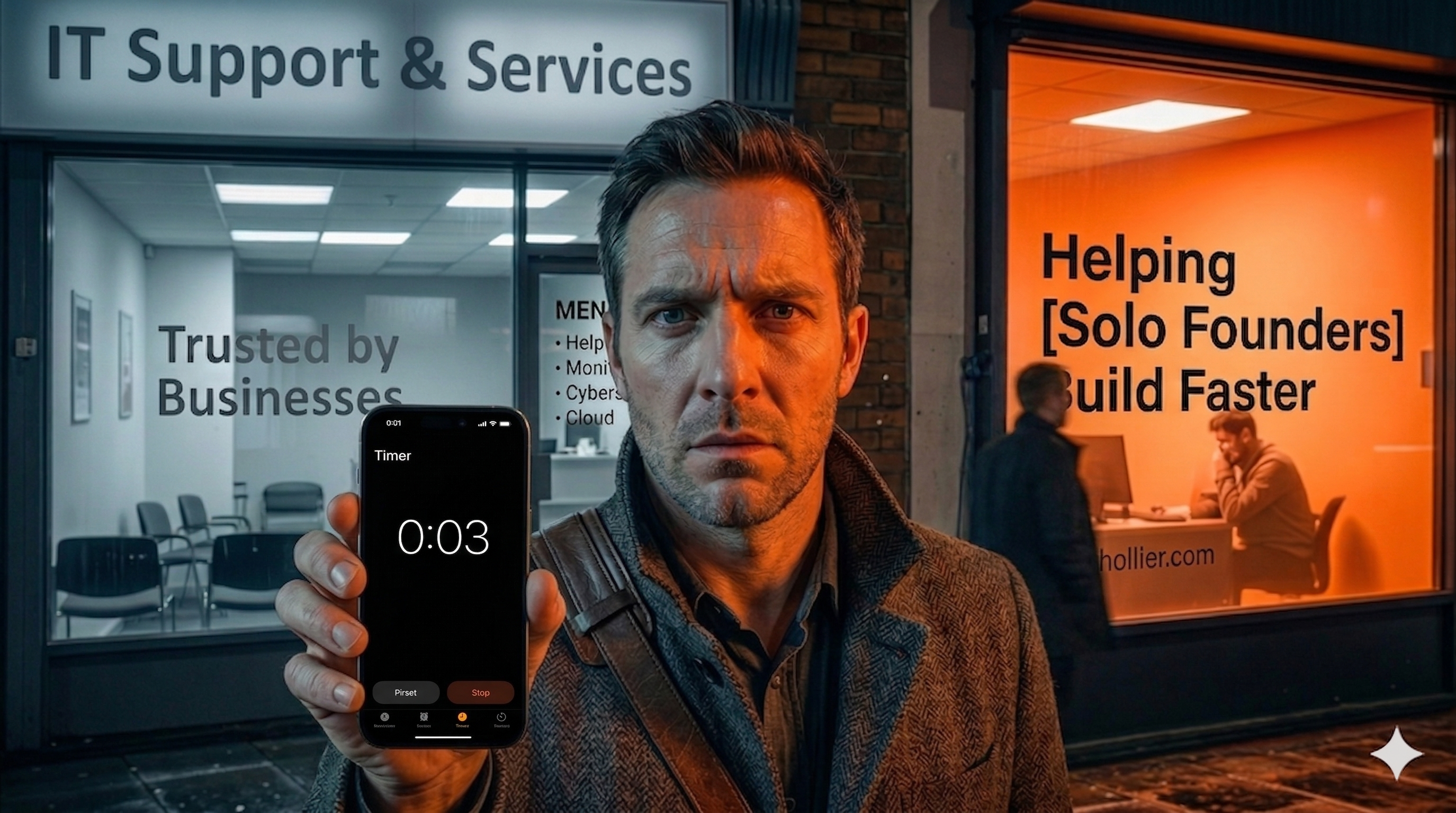
The headline says something like "We help businesses grow" or "Trusted IT solutions for companies of all sizes." Which is technically true and completely meaningless. It is the marketing equivalent of introducing yourself at a networking event by saying "I am a person who does things for other people." Accurate. Useless.
It describes what you do instead of what your client gets.
"Managed IT services. Cloud solutions. Proactive monitoring. 24/7 support." These are features. Your client does not buy features. Your client buys relief from the specific thing that is keeping them up at night. Features are the means. Relief is the end. Most founder marketing stops at the means and never reaches the end.
It could have been written by anyone.
This is the test I give founders whenever they show me their marketing: swap your logo for a competitor's logo. Does the messaging still work? If the answer is yes, even partially, you have cotton candy marketing. It is not specific to you. It is not specific to your client. It is not specific to the particular pain your particular client carries around every single day. It belongs to no one and therefore resonates with no one.
Now here is why this matters more in 2026 than it did two or three years ago.
AI has industrialized the production of cotton candy. Every founder with a forty-dollar-a-month subscription can now produce ten times more generic content in the same amount of time. Which means the feed is more saturated than ever. The noise is louder than ever. And the bar to actually stand out is higher than it has ever been.
The founders winning right now are not the ones producing more. They are the ones who have gotten more specific.
The Shift That Changes Everything
Here is the move.
Stop marketing to businesses. Start marketing to a vertical.
A vertical is a specific industry or market segment with its own vocabulary, its own recurring problems, its own internal culture, and its own definition of what a good day looks like versus a bad one.
Not "small businesses." Not "service-based companies." Not "growing organizations." A vertical is "independent dental practices with one to three locations." It is "regional civil engineering firms specializing in municipal infrastructure." It is "boutique insurance agencies with under 20 agents serving the agricultural market."
The more specific you get, the more your marketing sounds like it was written by someone who actually understands the person reading it.
Let me show you what that looks like in practice.
Here are two versions of a headline for an IT managed services company. Same service. Different approach.
Cotton candy version: "We help businesses streamline their IT so they can focus on what matters."
Vertical-specific version: "We help dental practices eliminate the five recurring IT problems that cause front desk chaos on Monday mornings. So your staff stops dreading the start of the week."
Same company. Same service. Completely different message.
The first version talks to everyone. The second version talks directly to a dental practice owner who has personally watched their front desk staff arrive on a Monday morning to a crashed scheduling system, a printer that stopped working over the weekend, or a patient management platform with a pending update that nobody installed. That owner knows exactly what "Monday morning chaos" means. They feel the cost of it every single week.
That second message gets forwarded. It gets screenshotted and sent to the office manager. It gets saved for later. It starts a conversation.
The first message gets scrolled past.
The Objection I Hear Every Time
Before I walk you through the framework, I want to address the objection that comes up every single time I talk about this.
"But Andrew, if I niche down I will lose potential clients who are not in that vertical."
Here is the deal. You are not niching down your service. You are niching down your message. You can still serve anyone. You are choosing to speak directly to someone.
And here is the counterintuitive truth that most marketing consultants will not tell you: speaking directly to one person makes everyone else feel like you might understand them too.
Think about it from the reader's perspective. If you are a restaurant owner and you read a piece of marketing that speaks precisely to the operational chaos of running a kitchen during a Friday night rush, the specific cost of food waste, the particular frustration of no-call-no-shows in a tight labor market, you feel seen. You feel like the person writing this actually knows your world.
But here is what also happens: the accountant reading the same piece thinks "this person really understands operational problems." The retail owner thinks "this sounds like someone who gets what it is like to run a business with unpredictable variables." The specificity signals expertise. It signals attention to detail. It signals that you care about your clients as people, not just as revenue sources.
Specificity creates trust at scale. Generic content creates nothing at scale.
The Vertical Lock Framework
Alright. Here is the practical side.
I use a four-step framework called Vertical Lock. It takes a founder from "we serve everyone" to a messaging foundation that actually resonates. You can run through all four steps in a single working session. I have done it with founders in as little as two hours from start to deployable first draft.
Step One: Pick the Vertical.
This is the decision most founders avoid. It feels like shrinking. It feels like closing a door. It is the opposite of both.
Pick the vertical where you do your best work. Where you already have one or two clients who love what you do. Where you understand the world well enough that you could sit down at lunch with someone in that industry and hold a real conversation about their actual problems, not just their surface-level needs.
One vertical to start. You can add more later, from a position of established credibility rather than desperation. The tighter the vertical, the stronger the first message.
A note on vertical definition: be specific. "Healthcare" is not a vertical. "Outpatient physical therapy clinics with two to five locations in mid-sized markets" is a vertical. The specificity of the definition directly predicts the specificity of the message.
Step Two: Learn the Language.
Every vertical has its own vocabulary. Its own fears. Its own industry-specific drama that insiders discuss constantly and outsiders never hear about. The founders who win in a vertical are the ones who sound like they belong there, not like they are trying to sell into it.
How do you learn the language fast? Two hours of intentional research.
Go to the industry association website for your target vertical. Read the headlines. Note the language they use to describe their own problems. Find the trade publication for that vertical and read the last three issues. Look at what topics are getting discussed repeatedly. Search LinkedIn for people with job titles in that vertical and read what they are posting about. Notice the phrases that come up again and again.
You are not trying to become an industry expert. You are trying to understand enough of the vocabulary and the recurring concerns to sound like someone who has been paying attention. That is enough to write resonant marketing. The rest comes from actual client conversations over time.
Step Three: Name the Pain.
This is the step that separates cotton candy marketing from marketing that converts. And it is the step where AI becomes genuinely powerful, when you use it correctly.
Every vertical has recurring pain. Not generic pain. Not "we want to grow" or "we need to be more efficient." Specific, named, embarrassing, expensive pain that every insider knows about but almost nobody in the marketing world ever mentions by name.
For a dental practice it is Monday morning system failures that delay the first patient of the week and put the entire front desk in catch-up mode for hours.
For a physical therapy clinic it is insurance claim rejections that take 45 days to chase down and resolve, tying up cash flow and consuming administrative hours that should be spent on patient care.
For a regional insurance agency it is the fact that their most experienced producers are five years from retirement and there is no succession plan in place, no documentation of relationships, no transfer of institutional knowledge.
Name that pain. By its actual name. In your marketing. Not euphemistically. Not generally. By the specific, recognizable, costly name that your target client uses when they talk about it with colleagues.
When you do this, the right people stop scrolling. Because for the first time in their experience of being marketed to, someone has described exactly what they are dealing with. Not a vague approximation of it. The real thing.
Step Four: Build the Message.
Now you bring in AI. Not to generate generic content. To help you articulate what you already know about this vertical in the most resonant, precise, and compelling way possible.
This is the distinction that separates the founders producing cotton candy from the ones producing marketing that actually converts. You are not asking AI to write your marketing from nothing. You are giving AI everything you know about the vertical, including the specific pains you identified in Step Three, the language you learned in Step Two, and the particular transformation your service creates, and asking it to help you express that knowledge in language that will land with a reader who lives in that world every day.
That is a completely different input. It produces a completely different output.
The prompt that produces cotton candy: "Write a LinkedIn post about IT services for small businesses."
The prompt that produces something real: "You are a copywriter with deep knowledge of the dental practice market. Here are five specific operational pain points that dental practice owners experience regularly. Write three opening lines for a cold email that names one of these pain points in the first sentence, makes the reader feel immediately understood, and does not mention the company or its services until at least the second paragraph."
Same tool. Different thinking brought to it. Completely different result.
Why the Camera Analogy Matters
I want to come back to the AI question one more time because I think this is important.
A camera does not make bad photos.
A photographer who has nothing to say, who has not thought about what they want to communicate, who is just pointing the lens at things and pressing the button, makes bad photos. The camera faithfully records whatever the photographer brings to it. Generic vision in. Generic image out. A real point of view in. Something worth looking at out.
AI works exactly the same way.
Template services work the same way.
Every content tool in existence works the same way.
The tool is the camera. The thinking is the photographer. And most founder marketing fails not because of bad cameras but because of photographers who never decided what they wanted to say or who they wanted to say it to.
The founders who will own their markets over the next three to five years are not the ones avoiding AI. They are not the ones throwing out their template libraries or cancelling their subscriptions in protest. They are the ones using every tool available, but bringing intentional, specific, vertically-focused thinking to every single one of them.
That is not a technology advantage.
That is a thinking advantage.
And thinking is the one thing no subscription service can provide for you.
What Happened to Marcus
After working through Vertical Lock, Marcus picked one vertical. Independent dental practices in his metro area. He spent two hours learning the language. He built a list of five specific, named pain points. And then he sat down with AI and built a messaging foundation that sounded like it came from someone who had spent years inside the dental world.
His first cold email referenced Monday morning system failures by name. It mentioned patient check-in delays. It talked about the specific cost of front desk downtime in the two hours between when the weekend ends and when the first patient is seated. It described the way office managers feel personally responsible when technology fails in front of patients.
He got three replies in 48 hours.
In six weeks of cotton candy marketing across both the template service and ChatGPT, he had received two responses total. Both were "not interested."
He did not change his service. He did not change his pricing structure. He did not add new capabilities or hire additional staff. He did not even change the tools he was using. He changed who he was speaking to and how specifically he was speaking to them.
That is the entire leverage point.
Specificity is the advantage. Vertical focus is the mechanism. The Vertical Lock framework is the path from where most founders are to where Marcus ended up.
Your Move
Here is what I want you to do before you read another blog post, watch another marketing tutorial, or write another piece of content.
Pick one vertical market you serve or want to serve.
Just one. Not three. Not "well it depends." One.
Now write down five problems specific to that vertical that a generic competitor would never mention. Not "they need better technology" or "they want to grow their revenue." Five specific, named, embarrassing, expensive problems that someone inside that world would read and immediately think: this person actually gets it.
That list is your marketing foundation. Every piece of content you write, every cold email you send, every LinkedIn post you publish, should be built on top of that foundation.
The founders who do this work produce marketing that converts.
The ones who skip it produce cotton candy.
And cotton candy looks great in the feed.
It just converts nobody.
This article is based on Season 1, Episode 1: "Cotton Candy Marketing Converts Nobody." Watch the full episode including a live AI build session and the complete Vertical Lock framework walkthrough at https://orangenomad.com/go/72cd2x.

Andrew Moon is the founder of Orange Nomad and the creator of the 3Cs Framework — a repeatable marketing system built for MSP owners under $5M who are great at IT but struggling to find clients. Not a marketer who learned about MSPs. An MSP owner who learned marketing — the hard way.