The Lead Magnet Nobody Reads (And What I Build Instead)
You sent a PDF to prospects last month. Maybe it was a checklist. A guide. A resource. Something you spent real time building.
Nobody read it.
Not really. They downloaded it. They opened page one. And then their life continued and your PDF sat in a downloads folder somewhere next to an old electric bill.
I did this for years. Spent real money on it. Kept wondering why my content was landing like a stone in still water.
The content was not the problem.
The Format Problem
Here is the number that should bother you.
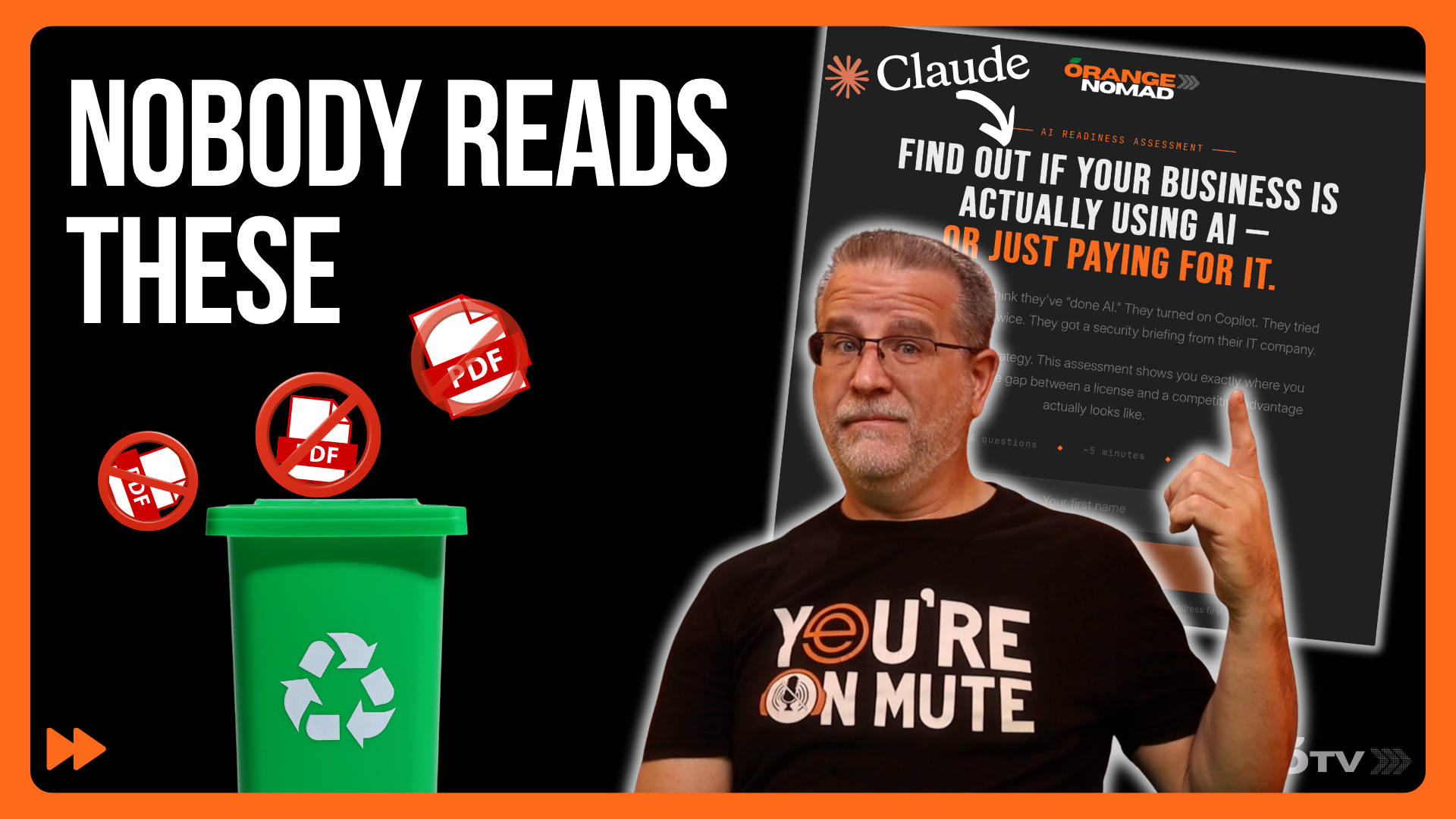
85% of content downloads are never opened past page one.
Not 15. Not 30. Eighty-five.
That means if you sent your PDF to a hundred prospects this month, roughly 85 of them opened it, saw the first page, and never came back. You did all that work. Wrote the thing. Branded it. Distributed it. And the return on that investment is a downloads count that tells you nothing useful about anyone.
This is not a content quality issue. Your content might be excellent. It is a format issue. And a format issue has a specific fix.
What an Interactive Assessment Does Differently
An interactive assessment has one rule that changes everything: the result only appears if you complete it.
You cannot skim-and-leave. You cannot open page one and close the tab. You have to answer the questions to get your score. And that single mechanic flips the entire engagement dynamic.
Your prospect is now invested. They answered 18 questions. They want to know what those answers mean. The result is gated behind their own participation.
Completion rates on well-built assessments run between 60 and 80 percent. On a PDF, you are lucky to get 15.
Then comes the part that makes assessments actually grow without advertising. When someone gets a personal score, they share it.
"I scored 14 out of 36 — what did you get?"
Nobody texts that about a PDF. Nobody forwards a vendor checklist to a colleague because they found it personally meaningful. But a tool that diagnoses where they actually are, in specific language that fits their situation, gets shared. Because sharing a result that says something true about you is a different act from passing along a document.
Four to five times the conversion rate. That is the measurable difference between a format that works and one that collects dust.
The Architecture Problem (Why Most Assessments Feel Generic)
Most people who decide to build an assessment start with questions. That is the wrong place to start.
Questions written without a structure behind them produce results that feel like a horoscope. Vague enough to apply to everyone. Specific to no one. "You're on a great journey toward AI adoption!" The person reads it, closes the tab, and tells nobody their score.
The architecture comes first. Three stages. Each stage diagnosing something different about where the person actually is. Each stage with a transformation statement that names the before and the after.
For an AI Readiness Assessment, the three stages might look like this:
Stage 1 diagnoses awareness. Does this business even know what AI tools they have and what they do? Stage 2 diagnoses activity. Are they actually building with AI, or did they just license it? Stage 3 diagnoses advantage. Is AI making them genuinely harder to compete with, or is it just background noise?
That structure means the questions have real diagnostic weight. And it means the results can be specific, because each score maps to a real pattern of behaviour rather than a number on a scale.
The Question That Makes People Pause
The difference between a useless assessment question and a useful one is specificity.
A useless question: "Do you use AI?"
Everybody will say yes. They opened ChatGPT once in November. They have a Copilot licence they have not touched. They are using AI.
A useful question: "Has AI saved your business measurable time in the last 90 days?"
That question is harder. It asks for a specific outcome in a specific timeframe. The prospect has to actually think about whether the answer is yes. And in that pause, something important happens.
They realise the gap between where they thought they were and where they actually are.
That gap is the value. That is what makes them want to see their score. That is what makes them, when they see the Tier 1 result, think: how did it know?
The Results Copy That Makes Them Share
Most people underinvest here. They get the architecture right, they write decent questions, and then they produce a lazy result. "You scored 18 out of 36. Great start! Keep going."
The person closes the tab.
The result has to feel like it was written for them specifically. Not for a category of person. For them. That is the difference between a tool someone uses once and a tool someone shares.
A Tier 1 result that works does not say "you're at the beginning of your journey." It describes the specific kind of business that gets this score. The business that has licensed AI tools but has not systematised any of them. The founder who is, in their own head, "doing AI," but when they see this result, they recognise exactly where they actually are.
Claude did not read their mind. Claude wrote a result for a real pattern of behaviour. But the person who fits that pattern reads it and thinks: how does it know?
That is not AI magic. That is good question design. And that is what makes them share their score.
The Build: Four Prompts in Claude
The full build takes 25 minutes. Four prompts inside a Claude Project.
The Project matters. Most people open a fresh Claude chat every time and start from zero. That is like walking into your own office and forgetting your name. A Project loads context once — your audience, your format, your tone — and every conversation inside it starts with that foundation already in place.
Prompt 1 designs the architecture. Three stages, transformation statements, two sample questions per stage. Claude returns the structure before a single full question is written. Get this right and everything else follows.
Prompt 2 writes all 18 questions from the architecture. A/B/C scoring, plain language, answerable in under ten seconds each. The instruction to keep language plain and jargon-free matters more than most people expect. These are business owners, not developers.
Prompt 3 writes the results copy for three score tiers. This is the most important prompt in the build. Each tier gets a specific diagnosis, three concrete actions, and a CTA that matches where that person actually is. Tier 1 to a free resource. Tier 2 to a group program. Tier 3 to a done-for-you service. The result self-selects your pipeline.
Prompt 4 writes the landing page. Under 150 words. Headline that names the gap, subline that makes the promise, three-stat strip that removes friction, paragraph that earns the click. Every sentence earning the next one.
That is the complete lead magnet. Architecture, questions, results copy, landing page. Four prompts.
What the Assessment Does for Your Business
Every person who completes this has told you exactly where they are.
They answered 18 questions honestly. They showed you their gaps. By the time they see their score, they are not a cold lead. They are a warm conversation.
Compare that to the PDF sitting in a downloads folder. The PDF is silent. It tells you nothing about who downloaded it, what they knew, where they are in the journey, or whether the content was relevant. It qualifies no one. It starts no conversation.
Every completion is data. Every score is a signal. Every share is free distribution. A lead magnet that qualifies your leads while they complete it is not a nice-to-have. It is a different category of tool.
Your Move
Open Claude. Start a new conversation inside a Project.
Paste this:
"I run a [type of service business]. My ideal client is [one sentence]. I want to build an interactive lead magnet assessment that helps them diagnose [the problem you solve]. Give me a 3-stage architecture with transformation statements and 2 questions per stage."
Do not start with the questions. Start with the architecture. Get the three stages right and everything else builds from there.
The live AI Readiness Assessment I built in the video is at orangenomad.com/ai-assessment. Take it. See your actual score — not where you think you are. Where you are.
If you want to build this kind of thing alongside other people doing it right now, the Build With AI Cohort waitlist is at orangenomad.com/ai-rollout.
Watch the full build here → https://youtu.be/xYMzC-DXtAY

Andrew Moon is the founder of Orange Nomad and the creator of the 3Cs Framework — a repeatable marketing system built for MSP owners under $5M who are great at IT but struggling to find clients. Not a marketer who learned about MSPs. An MSP owner who learned marketing — the hard way.