The Fishing Spot Problem: Why Generalist MSPs Stay Invisible No Matter How Good They Are
Sandra had been running her MSP for eleven years.
She'd supported manufacturers, law firms, dental offices, accounting practices, non-profits, a car dealership, and once — a yoga studio. She was genuinely good at all of it. Her team was sharp. Her response times were excellent. Her clients stayed.
And then, on a Tuesday afternoon, she lost a deal to someone who was only good at one of it.
The prospect was a manufacturing company. 47 employees. Clear IT pain. Two follow-up calls, a proper proposal, references ready. Sandra had done everything right.
The prospect said: "We really liked you. But we went with someone who specializes in manufacturing."
The competitor wasn't better at IT. Sandra probably knew that. The prospect probably knew it too. But the competitor had a website that said "IT for manufacturers" on the homepage. They had a case study from a manufacturer. They had a referral from someone in the same supply chain.
Sandra had a website that said: "We provide reliable IT support for businesses of all sizes."
She called me about six months after that conversation. She'd lost two more deals the same way. Different verticals, same reason. She was ready to have the conversation she'd been avoiding for a decade.
The Fishing Spot Problem
Here's the mental model that changes how MSP owners think about this.
There's a lake. Every weekend fisherman in the county knows about it. They all show up at the same spot on the bank — because that's where their buddy told them to go. They stand there shoulder to shoulder, lines in the water, wondering why they're not catching anything.
Meanwhile, there's a fisherman on the other side of the lake. Nobody knows about that spot. There's no trail to it. You have to want to find it. He catches fish every single time.
That is the MSP market.
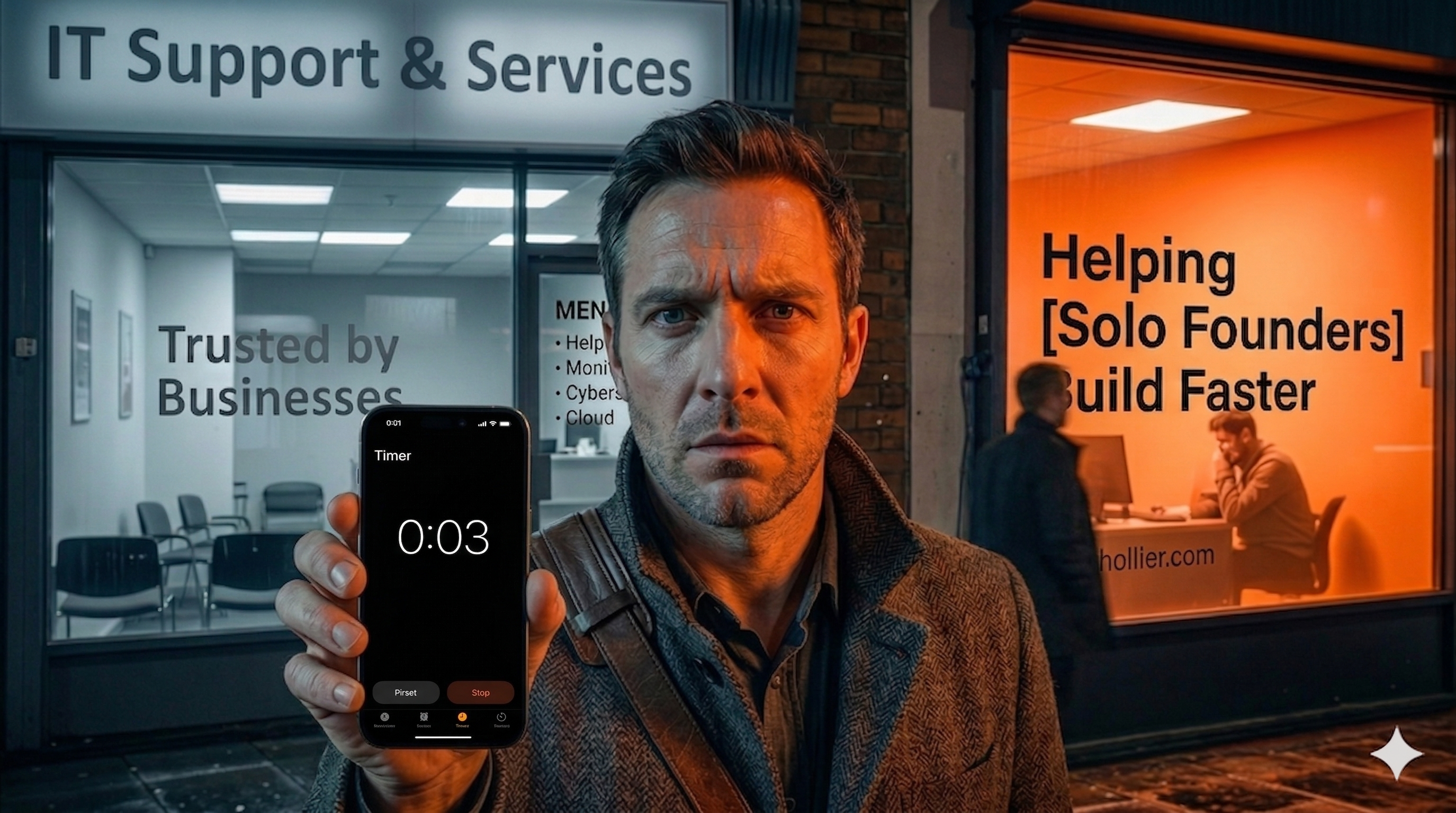
The crowded bank is the general IT support market. "We fix computers, manage your network, handle your helpdesk." That's where every MSP is standing, competing on price because there's nothing else to compete on.
The quiet spot on the other bank is your vertical.
When you pick a vertical, you don't give something up. You stop being one of forty and start being the only one. That is not a smaller market. That is an uncontested market.
Why Generalism Feels Safe (And Why That's the Problem)
I've had the niching conversation with a lot of MSP owners. It goes the same way every time.
I say: "Who's your ideal client?"
They say: "Small to medium businesses."
I say: "What industry?"
They say: "Any industry, really. We work across the board."
I say: "If you had to pick one?"
And they pause. And you can watch the fear come up. It sounds like objections. But it's fear.
The fear sounds like this:
"What if I pick wrong?"
"What if that vertical dries up?"
"What if I turn down a great client because they're in the wrong industry?"
Here's what I'd say to all of those.
Picking wrong is reversible. Picking nothing is not. You can change your niche. It's uncomfortable for about a quarter and then it's done. But staying generic compounds. Every year without a niche is another year competing on price, losing deals to specialists, and wondering why your referral pipeline isn't converting.
Pick a vertical that's been around for fifty years and will be around for fifty more. Dental. Legal. Financial. Manufacturing. Healthcare. These industries are not disappearing.
On turning down clients: niching your marketing doesn't mean niching your operations. When a great client shows up from outside your vertical, you evaluate them normally. The niche is about where you point your marketing, not who you're allowed to serve. You're not closing the door on anyone. You're opening a specific door and standing clearly in front of it.
Position, not operations. That distinction matters.
What a Real Vertical Looks Like
Two kinds of niching attempts. One works. One doesn't.
The one that doesn't work: "We specialize in small businesses with 10 to 50 employees."
That is not a vertical. That's a size range. A dental practice with 15 employees and a manufacturing company with 15 employees have almost nothing in common from an IT standpoint. Different compliance requirements. Different software ecosystems. Different security posture. Different language they use to describe their problems.
The one that works: "We specialize in dental practices across the Southeast."
That tells a prospect in three seconds that you know their world. When they call, they don't have to explain what Dentrix is. They don't have to brief you on HIPAA. They don't have to worry that you've never dealt with a practice management system before.
You've already done the work to be credible before you pick up the phone.
Here's the shortcut most MSPs miss. You probably already have a vertical. You just haven't named it.
Look at your current clients. If you've been in business more than three years, there is almost certainly a cluster. Two or three clients in the same or adjacent industries where you've built deep knowledge. You're already speaking their language. You just haven't led with it.
Your vertical isn't something you choose from a menu. It's usually something you discover in your own client list.
The Perfect Client Profile
Once you've named your vertical, you build the Perfect Client Profile. This is the foundation of Step 1 of the 3Cs Framework. Six components.
1. Vertical. The specific industry — not "small businesses." Dental practices. Multi-location legal firms. Healthcare groups. Manufacturing operations. Name the category precisely.
2. Company Size. Employee count and revenue range. This tells you the complexity of the engagement, the budget likely available, and whether the owner is still making decisions directly.
3. Geography. Your realistic service radius. Credibility in a vertical is regional first. Own your geography before you try to expand it. Being the dental MSP in your city is a defensible position. Being the dental MSP everywhere is not.
4. Pain Points. The specific frustrations your vertical faces that a generalist IT company wouldn't understand. For dental: HIPAA compliance, practice management software integration, imaging system failures, the panic when a server goes down and the entire schedule is blind. These are not generic pain points. They are earned from knowing the vertical.
5. Decision-maker Title. Who signs the contract. In a multi-location dental group, it's the practice owner or managing partner — not the office manager. They care about uptime, compliance, and not having to think about IT. They do not care about technical specs. Speak to the business outcome, not the technology.
6. Trigger Events. The specific moments that cause a prospect to actively look for a new MSP. Opening a second location. A data breach scare. A failed backup. A previous IT company that didn't understand their software. Know the trigger and you know when to show up.
That is a complete Perfect Client Profile. It tells you who to talk to, what to say, when to reach out, and how to earn credibility before you've said a single word.
What Happens After You Pick Your Spot
Here's the other side of this decision.
You change your homepage headline. You write one case study from your target vertical. You update your LinkedIn profile. You start posting about the specific IT challenges that vertical faces.
And something shifts.
Referrals start going vertical. When your existing dental client gets asked by a colleague for an IT recommendation, you're the obvious answer instead of one of several. The sales cycle gets shorter. You're not spending the first half of every discovery call educating the prospect on your credentials. They already believe you get it. Pricing power goes up. Specialists command specialist rates. You're no longer competing on price because there's no one else on your bank to compete with.
This is what Be the Signal means in the 3Cs Framework. Step 1 is not about being louder. It's about being the clearest, most credible option for a specific buyer. The fastest way to get there is to stop trying to be everything to everyone.
Sandra didn't get better at IT.
She got better at being findable to the people whose IT she was already best at.
Six months into her new positioning, her MRR had doubled. Twelve months in, she was getting inbound leads from dental offices who found her through referrals inside the vertical. People who never would have found her before. Because before, she wasn't anything in particular. Now she was the MSP for dental.
That's what the fishing spot gives you. You're not in a smaller lake. You're the only one on that bank.
The Move
Pull up your client list. Sort by MRR. Look at your top five.
Ask three questions about each one: What industry are they in? What's their employee count? What problem did they hire you to solve?
Write it down. Look for the pattern. There is almost always a pattern.
That pattern is your fishing spot.
You don't have to commit to anything today. Just find it. Name it. Write it at the top of the page.
If you want it turned into a professionally built Perfect Client Profile — and a complete 90-day marketing plan built around it — that's exactly what the 3Cs 90-Day MSP Marketing Action Plan does. $297. Delivered within 48 hours.

Andrew Moon is the founder of Orange Nomad and the creator of the 3Cs Framework — a repeatable marketing system built for MSP owners under $5M who are great at IT but struggling to find clients. Not a marketer who learned about MSPs. An MSP owner who learned marketing — the hard way.