Why Most MSPs Are Invisible (And How to Fix It in 30 Days)
Kevin had been in business for fourteen years.
Fourteen years of showing up, fixing problems, keeping networks alive. Solid operation. Good clients. The kind of MSP that runs quietly and reliably without needing to shout about it.
His business was built on referrals. One client told another. That client told two more. Kevin never had to think about marketing because he never needed to.
Then his biggest referral partner retired.
A guy who had sent Kevin six clients over eight years packed up and moved to Florida. No handoff. No replacement. No backup plan.
Kevin's pipeline didn't just slow down. It stopped.
So he did what most MSPs do in that situation. He Googled himself. Typed in "managed IT services" and his city name.
He wasn't on the first page. He wasn't on the second. He found his own website on page four.
The homepage had been live since 2011. It said: "We provide reliable IT support for businesses of all sizes."
That was it. That was the whole pitch.
Fourteen years in business. Zero positioning. And the moment his referral engine dried up, nobody could find him. The people who could find him couldn't tell him apart from the twelve other IT companies in the same city saying the exact same thing.
That's not a marketing problem.
That's a positioning problem.
The Real Definition of Invisible
Most MSPs think being invisible means having no website, no LinkedIn profile, no Google presence. That's one version. But it's not the one that kills most businesses.
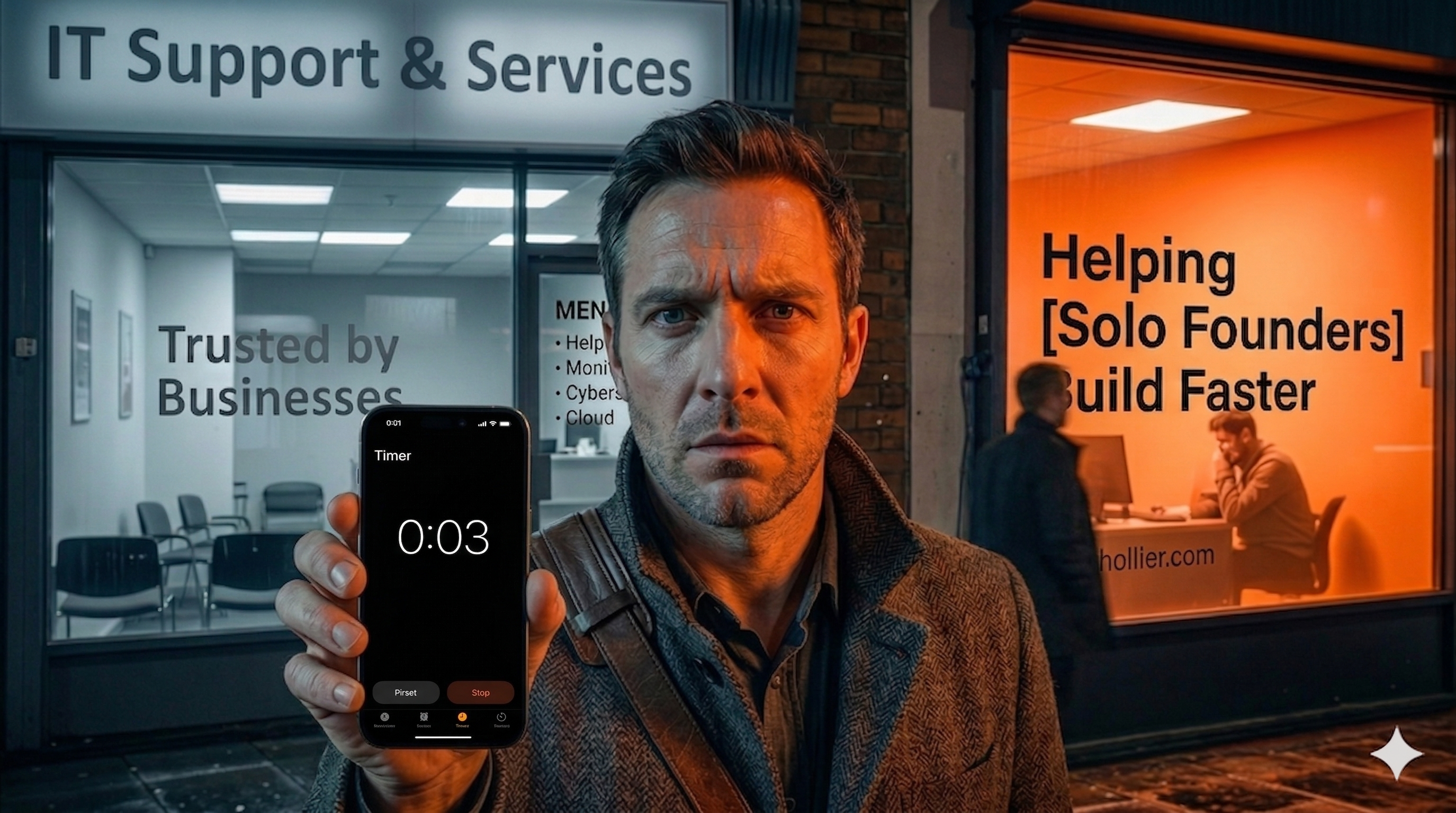
The version that actually hurts is subtler. You can have a perfectly functional website, a polished LinkedIn profile, even decent reviews on Google, and still be completely forgettable. Because nothing about any of it tells a stranger why you and not the other eight IT companies in the same search results.
That's the invisible that costs you deals.
In the 3Cs Framework, Step 1 is called Be the Signal.
Your Signal is the answer to one question: when someone in your market has the problem you solve, do they think of you?
Not "would they hire you if they knew you existed." That's a different question.
Do they think of you at all?
For most MSPs, the answer is no. And not because of effort. Because of sameness.
Generic is the enemy of Signal. "We provide great IT support" is not a positioning statement. It's a placeholder.
Why MSPs Default to Generic
Here's the part that surprises most people. MSPs don't default to generic because they're lazy. They default to generic because specificity feels like risk.
When you say "we help dental practices in the Midwest manage their IT infrastructure compliantly," you're making a claim. You're narrowing the aperture. You're saying: this kind of client, not every client.
That feels like leaving money on the table.
It's not. What actually happens when you get specific is the opposite.
You stop competing on price with companies that look identical to you. You start attracting clients who already believe you understand them before the first call. Your sales cycle gets shorter because the prospect has already pre-qualified themselves. The question shifts from "why should I hire you" to "when can you start."
The MSPs I've seen grow the fastest aren't the ones who got louder. They're the ones who got clearer.
Loud and generic is noise. Clear and specific is Signal.
And here's the thing about Signal that most marketing advice misses: it's not about what you do. It's about who you do it for and what it means for them.
You don't fix servers. You keep a dental practice from failing a HIPAA audit.
You don't provide IT support. You make sure a law firm can bill hours without systems going down.
Same technical work. Completely different Signal.
The MSP who says the second version is not better at IT than the one who says the first. They're just better at positioning. And in the market, that's worth more.
The Three-Blank Framework
So how do you build your Signal?
There is a fill-in-the-blank framework that cuts through the noise every time. It works because it forces three decisions that most MSPs have been avoiding, consciously or not.
It goes like this:
"We help [ICP] [achieve outcome] [in a way competitors can't claim]."
Three blanks. Three decisions. Here's what each one actually requires.
Blank 1: Your Ideal Client Profile
Not "small businesses." Not "businesses of all sizes." A real category.
An industry. A size range. A geography. Something specific enough that if you said it out loud in a room, the right people would raise their hand and the wrong ones wouldn't.
Most MSPs resist this blank because they've been trained to think broader is better. It isn't. Broader means you're competing with everyone. Narrower means you're competing with almost no one.
Pick the vertical where you make the most money, have the most clients, or genuinely want more work. Start there.
Blank 2: The Outcome
Not the service. Not the feature set. Not "managed IT support."
The outcome your client actually cares about. Compliance. Uptime. Growth without IT headaches. The thing they'd describe to a friend when they're explaining why they hired you.
A useful test: if you swapped "outcome" for "service" in your positioning and a stranger couldn't tell the difference, you haven't written the outcome yet. Write it in language your client uses, not language IT uses.
Blank 3: The Differentiator
This is where most people get stuck.
The third blank is the thing only you can say. Not a claim about being better. A claim about being the only one who does this, for this client, in this way.
It might be years of experience in a specific vertical. A proprietary process. A response time commitment backed by a financial guarantee. A team that has lived inside the industry they now serve.
Most MSPs know what their differentiator is. They just haven't been forced to name it out loud. The reason your best clients stay isn't "because you do good IT." It's something more specific. Find that thing and put it in blank three.
If you can finish all three blanks, you have a Signal.
If you can't finish the third one, that's the gap. That's the work that has to happen before you spend another dollar on marketing.
The Analogy That Makes This Stick
Think about how radio works.
Every radio station is broadcasting all the time. They're all on the spectrum. They're all putting out signal. But if two stations are on the same frequency, all you get is static.
Most MSPs are broadcasting on the same frequency. Same message, same language, same pitch. The result is static. Nobody tunes in because nobody can tell you apart.
Building your Signal means claiming your own frequency. Something specific enough that when your ideal client tunes in, they hear nothing but you.
Kevin eventually found his frequency. His best clients were professional services firms, and within that, law firms made up the majority of his MRR. He'd been serving them for a decade. He knew the software, the compliance requirements, the billing pressures, the vendor relationships.
He rewrote his Signal: "We help mid-size law firms in the Pacific Northwest keep their systems compliant and their billable hours uninterrupted, backed by ten years of legal IT experience."
He updated his homepage. He rewrote his Google Business Profile. He updated his LinkedIn headline.
His time-to-close on new leads dropped from six weeks to twelve days. Not because he got better at IT. Because he finally got on the right frequency.
What Happens After Signal
Signal is Step 1 in the 3Cs Framework for a specific reason. Not because it's the most exciting step, but because everything else depends on it.
Your Google Business Profile needs Signal. Otherwise you're just another "Managed IT Services" listing that blends into the page.
Your lead magnet needs Signal. Otherwise you're competing with every IT ebook and checklist already out there.
Your nurture sequence needs Signal. Otherwise every email sounds like it could have come from any MSP in any city.
Signal isn't the beginning of your marketing. It's the foundation your marketing sits on. Build it wrong and every subsequent step amplifies your genericness. Build it right and every step in the 3Cs compounds your distinctiveness.
The good news: you don't need a rebrand. You don't need a new logo or a new website or a new offer.
You need one clear statement that tells the right people exactly what you do, for whom, and why you're the one to do it.
Twenty minutes. Three blanks. That's the starting point.
The Move
Open a blank document. Write this at the top:
"We help [ICP] [achieve outcome] [in a way competitors can't claim]."
Fill it in.
Don't overthink it. Write the first draft. Even if it's rough, you now have something to improve, test, and sharpen.
If you can finish all three blanks, you have a Signal. Put it on your homepage. Update your LinkedIn headline. Rewrite your Google Business Profile description. See what changes.
If you can't finish the third blank, that's your work. That's where the clarity has to come from before anything else you do in marketing will stick.
And if you want this built professionally, with your real ICP, your actual differentiators, and a full 90-day plan built around your Signal, the 3Cs 90-Day MSP Marketing Action Plan does exactly that. $297. I'll deliver it within 48 hours.
Link is in the comments on the episode.

Andrew Moon is the founder of Orange Nomad and the creator of the 3Cs Framework — a repeatable marketing system built for MSP owners under $5M who are great at IT but struggling to find clients. Not a marketer who learned about MSPs. An MSP owner who learned marketing — the hard way.